
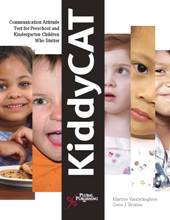
KiddyCAT Communication Attitude Test for Preschool and Kindergarten Children Who Stutter
First Edition
Martine Vanryckeghem, Gene J. Brutten
Details: 28 pages, Print, B&W, Softcover, 8.5" x 11"
ISBN13: 978-1-59756-117-4
© 2007 | Available
Purchase Print Book
Price: $99.95
The KiddyCAT is a companion test to the Behavior Assessment Battery for School-Age Children and Adolescents Who Stutter (BAB) designed for use with children under the age of six. It enables effective assessment of the speech-associated attitude of preschool and kindergarten children. The instructions and the test items are specifically formulated at the linguistic level of this age group.
The Test is comes with:
- resource manual
- quick-access scoring key
- and the methodology for data interpretation
The KiddyCat is only available as a print package. To replenish your supply of KiddyCAT forms, visit the KiddyCAT Reorder Set page.
Reviews
- "The KiddyCAT was designed for use with children between 3 and 6 years of age ... Even at this young age ... children who stutter revealed significantly poorer speech-associated attitude than [their] ... fluent peers." —Oliver Bloodstein and Nan Bernstein Ratner, in A Handbook on Stuttering (2008)
- "...it is important that young children's feelings and reactions to their own stuttering and their general sense of well-being are addressed. To this end, the development of the KiddyCat is a welcome clinical tool, given the paucity of standardised evaluations of this nature for very young children who stutter. The KiddyCat is an easy-to-administer test that has been specifically design by speech pathologists to assess the speech-associated attitudes of very young children. The development of the took took into consideration Brutten's (1984) Communication Attitude Test (CAT) for children and the practical and linguistic limitations for use with children younger than six years." —Elizabeth A. Cardell, BSpThy, MSpPath, LCST(London), PhD; MSPA, CPSP, International Journal of Disability, Development and Education (2010)
- Clark, C., Conture, E., Frankel, C., & Walden, T. (2012). Communicative and psychological dimensions of the KiddyCAT. Journal of Communication Disorders, 45, 223–234. doi:10.1016/j.jcomdis.2012.01.002
- “This independent replication suggests at least two thing:s 1) the KiddyCAT is one viable, seemingly reliable means for distinguishing the speech-associated attitudes of preschool-age CWS from preschool-age CWNS and 2) even at this young age, at or near the onset of stuttering, preschoolers have formed or are forming attitudes towards speaking that may either facilitate (in the case of CWNS) or inhibit (in the case of CWS) their ability to establish normally fluent speech-language planning and production” (p. 230).
- “Taken together, the single factor—‘‘speech difficulty’’—underlying the KiddyCAT appears related to communicative and psychological processes. This factor seems appropriate on both empirical (i.e., principal components analysis) as well as conceptual (i.e., the quality of the factor) grounds. Thus, present findings support the inclusion of the KiddyCAT as part of a comprehensive approach to the assessment of childhood stuttering. These findings also appear to help improve our ability to interpret KiddyCAT findings as well as further our understanding of how attitudes and awareness contribute to developmental stuttering in preschool-age children” (p. 232).
- Stokke Guttormsen, L., Kefalianos, E., & Næss, E. (2015). Communication attitudes in children who stutter: A meta-analytic review. Journal of Fluency Disorders, 46, 1-15. http://dx.doi.org/10.1016/j.jfludis.2015.08.001
- “The KiddyCAT and the CAT have been extensively researched, both instruments showing good validity and reliability” (p. 3).
- “In line with many studies of communication attitudes (e.g. Clark et al., 2012; De Nil & Brutten, 1990; Kawai et al., 2012; Vanryckeghem et al., 2001) our results confirm that CWS have significantly more negative communication attitudes than CWNS. The difference between CWS and CWNS was evident for preschool and school-aged children” (p. 9).
- “Measurement of communication attitudes prior to commencing treatment and after completing treatment is necessary to determine whether (1) children with more negative communication attitudes respond as effectively as children with less negative communication attitudes to treatment; (2) communication attitudes influence treatment time; (3) effective treatment impacts on a child’s communication attitudes; (4) the presence of negative communication attitudes after treatment heightens the risk of relapse” (p.12).
- Groner, S., Walden, T., & Joness, R. (2016). Factors Associated With Negative Attitudes Toward Speaking in Preschool-Age Children Who Do and Do Not Stutter. Contemporary Issues in Communication Science and Disorders, 43, 255-267. https://pmc.ncbi.nlm.nih.gov/articles/PMC5627653/
- “…the KiddyCAT is consistently able to capture the negative attitudes that preschool CWS have toward the difficultness of their speech. Using the instrument as part of a continuing, holistic assessment of the nature and impact of young children’s stuttering to create the most effective treatment plans is recommended” (p.263).
- "Illumination of exactly how CWS’s attitudes toward their stuttering change with recovery would be an invaluable addition to SLPs’ arsenals” (p. 263).
- “The KiddyCAT most saliently measures whether children perceive speech as difficult” (p. 264).
- “...using both caregivers’ data about their children’s speech and the children’s own self-reported attitudes could give clinicians a better picture of how stuttering impacts their clients outside the narrow window of a clinical setting” (p. 264).
- “…the KiddyCAT is a useful tool in the comprehensive assessment of childhood stuttering (p. 266).
- Winters, K., & Byrd, C. (2021). Predictors of communication attitude in preschool-age children who stutter. Journal of Communication Disorders, 91. https://doi.org/10.1016/j.jcomdis.2021.106100
- …useful recommendations for speech-language pathologists working with preschool-age children who may stutter. First, because stuttering severity does not predict communication attitude, clinicians should incorporate an assessment of communication attitude in their evaluation of preschool-age children who may stutter” (p. 7).
- “…clinicians should also consider negative communication attitude as a target for intervention” (p.7).
- “Facilitating and maintaining a positive communication attitude in early childhood may further support children as they enter elementary school” (p.7).
- “…there is evidence to support early intervention for your children who stutter in order to facilitate positive communication attitudes…” (p.7).
- Winters, K., & Byrd, C. (2024). Caregiver Predictions of Their 3-to 6-Year-Old Child Who Stutters’ Communication Attitude. Journal of Speech-Language and Hearing Research, https://doi.org/10.1044/2024_JSLHR-23-00662
- “The KiddyCAT is the only standardized self-report scale measuring children’s cognitive reactions to communication, or speech-associated attitude, in children under 7 years of age” (p.2).
- “The KiddyCAT consistently demonstrates group differences between young children who stutter and who do not stutter” (p.7).
- “ …these data support both clinical and research efforts to measure cognitive components of stuttering separately from analyses related to observed stuttering behaviors” (p. 15)
- “SLPs [should] also consider a change in communication attitude as an independent, clinically meaningful intervention outcome” (p. 15).

Martine Vanryckeghem
Martine Vanryckeghem, PhD received her Master's Degree (1991) and PhD (1994) from Southern Illinois University, Carbondale, after having worked for 12 years as a speech-language pathologist at a Clinical Center in Belgium. Dr. Vanryckeghem started her academic career at the University of Central Florida (UCF) in 1994. She is clinically certified as a speech-language pathologist, is an ASHA Fellow, a Board Certified Specialist in Stuttering, Cluttering, and Fluency Disorders and European Fluency Specialist. She has published widely in peer-reviewed journals and has given lectures and workshops, internationally, with respect to the assessment and treatment of children and adults who stutter. She is the co-author of the Behavior Assessment Battery (BAB) for Children and Adolescents who Stutter, the Behavior Assessment Battery (BAB) for Adults who Stutter, and the Communication Attitude Test for Preschoolers and Kindergartners who Stutter (KiddyCAT) which have been researched in 30+ countries. For her international endeavors, Prof. Vanryckeghem received ASHA’s Certificate of Recognition for Outstanding Contribution in International Achievement and is a Fulbright recipient. From 1990 until 2000, she was managing editor of the Journal of Fluency Disorders and is an editorial board member for several professional journals. Dr. Vanryckeghem is on the Scientific Board of different internationally-based organizations and serves as a consultant to faculty and students. She has been a guest professor at the University of Gent, Belgium and the University of Utrecht, the Netherlands. She is a faculty member, coach and partner of the post-graduate European Stuttering Specialization (ESS) course. In August 2025, Dr. Vanryckeghem became Pegasus Professor Emerita at UCF.

Gene J. Brutten
Gene J. Brutten, PhD received his PhD from the University of Illinois, and was clinically certified in speech pathology and audiology by the American Speech-Language-Hearing Association. He was a fellow of the association and was awarded its Certificate of Recognition and Certificate of Appreciation. Professor Brutten was a founding member of the International Fluency Association and served as the editor-in-chief of its Journal of Fluency Disorders from 1989 to 2000. In 1971 and again in 1978, he received a Fulbright-Hays award to the Department of Foniatrie at the University of Utrecht Academic Hospital, the Netherlands, where he conducted clinically-based research. He co-authored the seminal book "Modification of Stuttering," has published more than 80 peer-reviewed journal articles, 20 book chapters, and has given over 200 professional presentations in three continents on differential assessment and behavior therapy. Dr. Brutten was an emeritus professor in the Southern Illinois University Department of Communication Disorders and Sciences, where he served as department chair, and in its Department of Psychology. In 2002, Dr. Brutten received the Honors of the American Speech-Language-Hearing Association, and in 2009, he was similarly honored by the International Fluency Association. Dr. Brutten passed away in March 2013.
KiddyCAT Reorder Set Communication Attitude Test for Preschool and Kindergarten Children Who Stutter
First Edition
Martine Vanryckeghem, Gene J. Brutten
Details: 50 pages, B&W, Pad, 8.5" x 11"
ISBN13: 978-1-59756-124-2
© 2007 | Available
Behavior Assessment Battery for Adults Who Stutter (Online Access)
First Edition
Martine Vanryckeghem, Gene J. Brutten
Details: Online Access
ISBN13: 978-1-59756-901-9
© 2018 | Available
Behavior Assessment Battery for School-Age Children and Adolescents Who Stutter
Second Edition
Martine Vanryckeghem, Gene J. Brutten
Details: Online Access
ISBN13: 978-1-63550-341-8
© 2026 | Available