
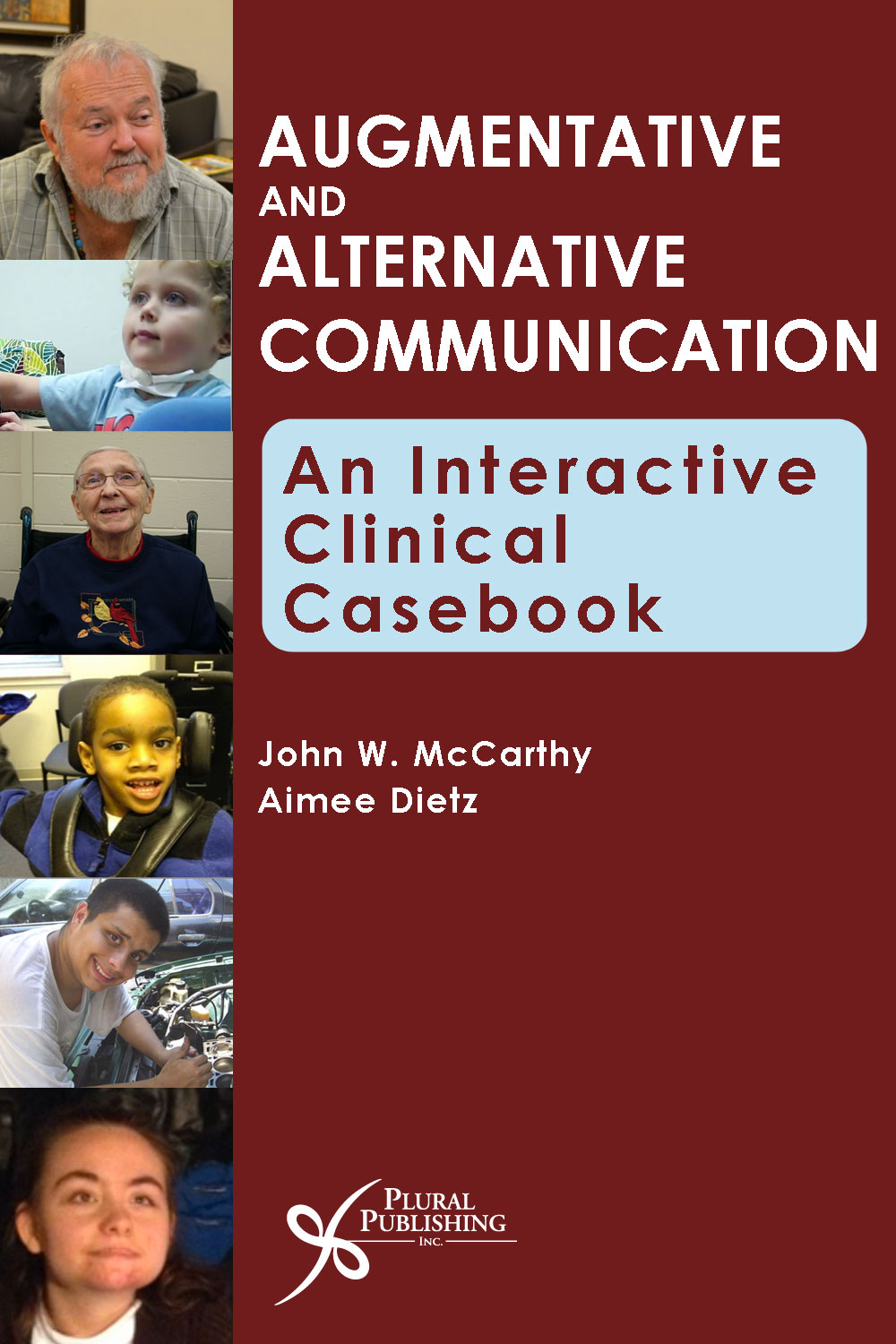
Augmentative and Alternative Communication: An Interactive Clinical Casebook
First Edition
John W. McCarthy, Aimee Dietz
Details: NOTE: THIS INTERACTIVE ONLINE PRODUCT IS ONLY VIEWABLE USING FIREFOX BROWSER.
© 2015 | Available
*** Please note that the online Augmentative and Alternative Communication: An Interactive Clinical Casebook, is a computer program (not an ebook) and is only usable with the FIREFOX browser. It does not work on mobile devices. After you purchase this product, you will be sent an access code via email. Then click on the Companion Site link to register your code and access the casebook online.| ***
Augmentative and Alternative Communication: An Interactive Clinical Casebook is a multimedia educational tool, available as an e-learning, web-based program, that is a valuable resource to instructors, students, and practicing clinicians. It presents 13 clinical stories written and narrated by augmentative and alternative communication (AAC) experts. These stories present a framework for assessment and treatment service delivery across a wide variety of people with complex communication needs.
Key features include:
- Narration: Each chapter features audio commentary (and written transcriptions) from the authors that illustrate their decision-making process in determining an approach to assessment and intervention.
- Multimedia content: Chapters feature videos and photos, as well as sample clinical forms, notes, and reports.
- Diverse selection: Chapters span across age ranges and address various developmental and acquired disabilities.
- Consumer perspective: Noah Trembly, a man who uses AAC, provides the consumer perspective on this resource in the preface in the Introduction chapter. In 2014, Mr. Trembly was selected to present the 18th Annual Edwin and Esther Prentke Distinguished Lecture at the American Speech-Language-Hearing Association national convention.
Instructors: This online casebook bridges classroom and practicum instruction and facilitates discussion of clinical issues and techniques. Although every person who uses AAC is different, the structure of assessment and intervention planning is similar across all chapters. The authors' commentary on assessment and intervention, available through audio or as a transcript, expands the possibilities for use in or out of the classroom.
Students: In a field where evidence and theory must merge with clinical practice, students need practical examples of people who use AAC and access to experts who model best practice. As this casebook is 100% digital, students receive expert models from professionals in the AAC field and have access to explore a vast array of AAC-related topics.
Practicing Clinicians: The range of individual disorders within AAC is far-reaching and a clinician's area of focus is always subject to change. This casebook provides clinicians with ready access to various models of service delivery for quick reference and detailed instruction on specific areas of AAC practice.
*** Please note that the online Augmentative and Alternative Communication: An Interactive Clinical Casebook, is a computer program (not an ebook) and is only usable with the FIREFOX browser. It does not work on mobile devices. After you purchase this product, you will be sent an access code via email. Then click on the Companion Site link to register your code and access the casebook online.| ***
Introduction: John W. McCarthy and Aimee Dietz, Editors
Preface by Noah Trembly
Acknowledgments
How to Navigate the AAC Interactive Clinical Casebook
Overview of the Resource
Chapter Organization Overview
CHAPTERS:
Chapter 1 Pete: A Retrospective Look at an Infant/Toddler with Multiple Impairments: From Early Signals to Expanded Development
Cynthia Cress
Chapter 2 Colin: A Preschooler who is Medically Fragile but Ready to “Take off” with Communication
Jennifer Kent-Walsh, Pamela Resnick, Cathy Binger
Chapter 3 Sam: Independent Communication versus Access: Bridging the Gap for a Young Child with Cerebral Palsy
Jacquelyn Kearns
Chapter 4 Brady: An Individual with Significant Physical Disabilities and Cortical Visual Impairment
Jill Tullman, Michelle L. Lange
Chapter 5 Chelsea: Access for a Young Adult with Rett Syndrome
Sandra Grether, Caitlin Leahy
Chapter 6 Eddie: Multimodal Strategies for a Young Adult with Autism
Byron Ross, Dena Linda
Chapter 7 Tom: Supporting an Adult with an Intellectual Disability through AAC
Elizabeth Hanson
Chapter 8 Jeff: No-Tech AAC use by a Person with Traumatic Brain Injury
Sarah Wallace, Annette Baft-Neff
Chapter 9 Jane: Maintaining Function in a Person with Early-Onset Dementia using Low-Tech AAC
Michelle Bourgeois
Chapter 10 Tim: A Multimodality Communication Approach in a Person with Severe Aphasia
Kristy Weissling, Miechelle McKelvey
Chapter 11 Betty: Supporting Communication for a Person with Aphasia
Julia King
Chapter 12 Mary: Implementation of AAC in a Person with Spinal (Limb) Onset ALS
Amy Roman, Wendy Quach
Chapter 13 Special Chapter: AAC for Adults in Acute Care
Richard Hurtig, Debora Downey, Lauren Zubow
References
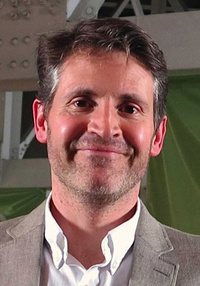
John W. McCarthy
John W. McCarthy, PhD, CCC-SLP, is a speech-language pathologist specializing in children and young adults with complex communication needs requiring augmentative and alternative communication (AAC). Currently he is an Associate Professor and the Associate Director of Communication Sciences and Disorders at Ohio University. He teaches courses in AAC, Language Development, Introduction to Communication Disorders, Research Methods, and Interprofessional Education. Dr. McCarthy's primary research interests include: developing better AAC computer user interfaces for children, expanding the creative possibilities for children and young adults with complex communication needs, and student-constructed classroom content to build teams and share knowledge.
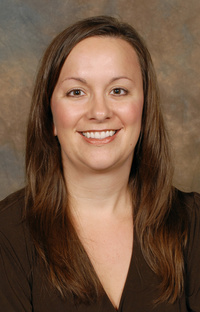
Aimee Dietz
Aimee Dietz, PhD, CCC-SLP, is a speech-language pathologist specializing in neurogenic communication disorders and augmentative and alternative communication (AAC). Dr. Dietz is an associate professor in the Department of Communication Sciences and Disorders at the University of Cincinnati, where she teaches courses in the areas of AAC, aphasia, and motor speech disorders. Her primary research interests concern the development of AAC interventions, which help people with aphasia simultaneously recover language and compensate for deficits. Specifically, Dr. Dietz is interested in using neuroimaging technologies such as functional magnetic resonance imaging (fMRI) and diffusion tensor imaging (DTI) as biomarkers for AAC treatment-induced language recovery in people with aphasia.
Please note that the online Augmentative and Alternative Communication: An Interactive Clinical Casebook, is a computer program (not an ebook), and is meant to be used with Firefox 2020 or earlier on a computer.
It does not work on mobile devices (phones and tablets). The program uses Flash and if your computer won't allow Flash, the program will not work.
After you purchase this product, you will be sent an access code via email. Then click on the Companion Site link to register your code and access the casebook online.