
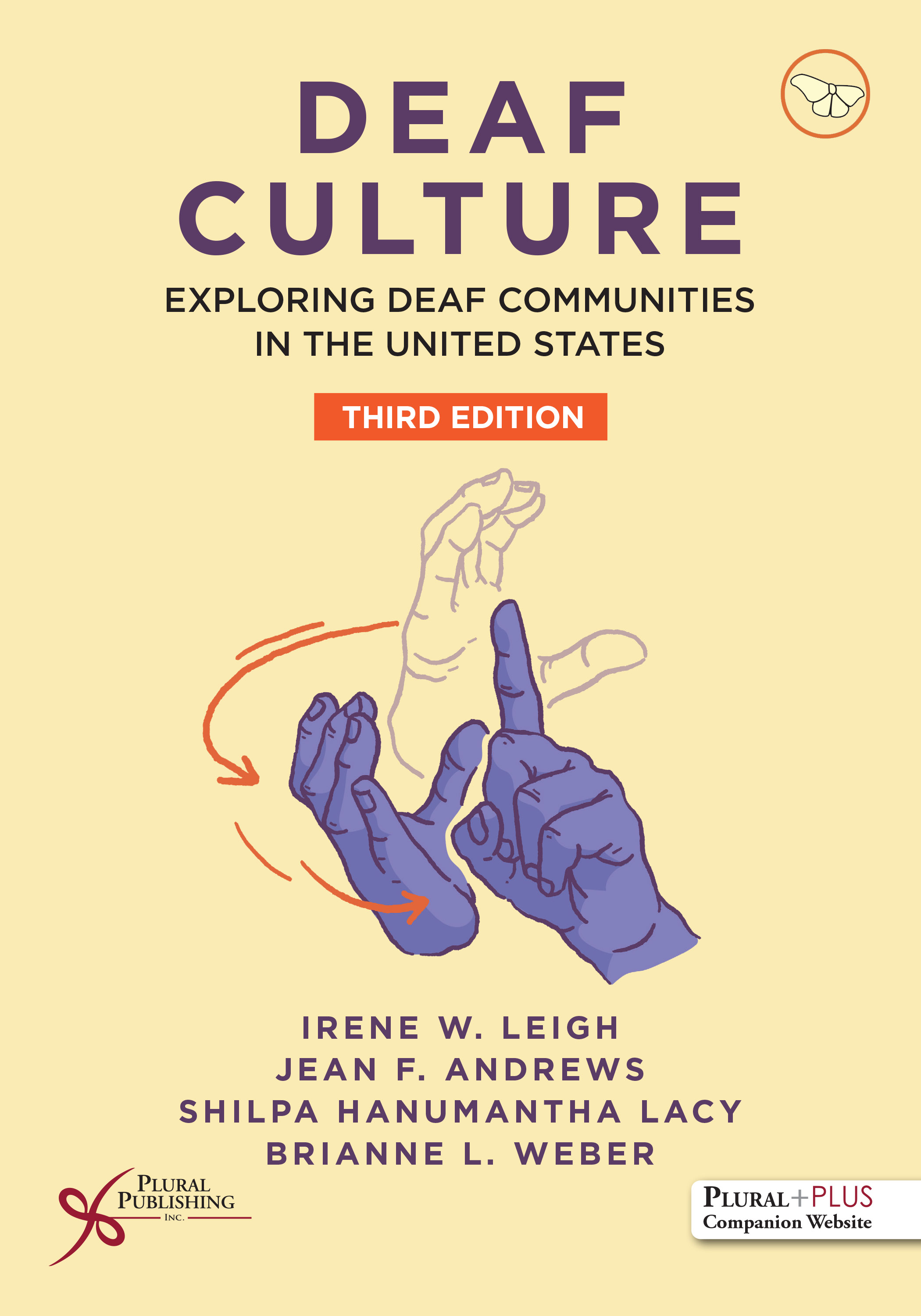
Deaf Culture: Exploring Deaf Communities in the United States
Third Edition
Irene W. Leigh, Jean F. Andrews, Shilpa Hanumantha Lacy, Brianne L. Weber
Details: 425 pages, B&W, Softcover, 7" x 10"
ISBN13: 978-1-63550-740-9
© 2028 | Coming Soon
Release Date: 12/31/2026
For Instructors
Purchase
Available for purchase starting 12/24/2026
Print Book: $89.95
eBook: $89.95
Deaf Culture: Exploring Deaf Communities in the United States, Third Edition offers an engaging, culturally affirming introduction to the history, languages, identities, and lived experiences of Deaf communities. This best-selling text combines historical foundations, contemporary scholarship, and authentic Deaf perspectives to explore cultural belonging, diversity, and the contributions of Deaf people to society. Its interdisciplinary approach connects Deaf culture with education, psychology, audiology, technology, legal rights, and the arts. The text is ideal for introductory undergraduate courses in Deaf studies, American Sign Language, communication sciences and disorders, special education, and related fields.
Written by a collaborative team of Deaf and hearing scholars, the book explores how language access, family experiences, and education shape Deaf children’s development and learning. It examines hearing differences and auditory technologies from a Deaf-centered perspective and follows Deaf experiences across the lifespan, including relationships, employment, health, and aging. Discussions of identity, cultural expression, advocacy, and careers help students build cultural awareness for future study and professional practice. Clear explanations, case examples, and reflective activities connect key concepts with real-world experiences. QR-linked ASL videos captioned in English bring Deaf perspectives directly to students, creating a dynamic bilingual, multimodal learning experience.
Two new coauthors, Shilpa Hanumantha Lacy, PhD, and Brianne L. Weber, PsyS, bring additional expertise in psychology, deaf education, language access, and intersectional Deaf experiences.
New to the Third Edition
Significant updates throughout reflect contemporary developments in Deaf communities, scholarship, technology, and professional practice, including:
- Two new chapters on Deaf people and the legal system examine communication access, hearing bias, and Deaf rights in education, healthcare, employment, and criminal justice through case histories and videos.
- A substantially revised chapter on communities within the Deaf community explores Black, Latine, Asian, Indigenous, LGBTQ+, DeafBlind, DeafDisabled, immigrant, and multilingual experiences, emphasizing intersectionality, resilience, and advocacy.
- Broader coverage of signed-language diversity includes Black American Sign Language, Indigenous sign languages, and ProTactile.
- Expanded discussion of Deaf-centered education addresses early language access, language deprivation, literacy development, bilingual education, translanguaging, and multimodal learning.
- New discussions of artificial intelligence (AI) and emerging technologies examine opportunities and limitations in accessibility, ASL learning, and education, emphasizing Deaf-led innovation.
- Updated coverage of Deaf leadership, healthcare, mental health services, arts, media, and careers highlights contemporary contributions and opportunities.
- QR codes throughout the text connect readers to videos and online supplementary information.
Key Features
- Clear, student-friendly explanations introduce essential concepts and theoretical frameworks.
- Text boxes and reflective activities deepen understanding, encourage discussion, and promote critical thinking.
- Case histories and contemporary examples connect cultural concepts with experiences in education, healthcare, employment, and the legal system.
- Chapter resources, including videos and web links support further exploration beyond the text.
- Ancillary resources for instructors, including PowerPoint slides and a test bank, support teaching and assessment.
PluralPlus Online Ancillaries
For instructors: PowerPoint Slides, Test Bank, Links to Videos
For students: Chapter Quizzes, Links to Related Resources
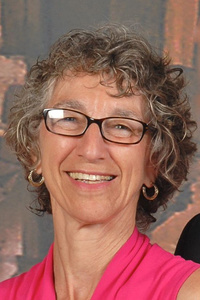
Irene W. Leigh
Irene W. Leigh, PhD, is a Deaf psychologist whose experience includes high school teaching, psychological assessment, psychotherapy, and private practice. From 1985 to 1991 she was a psychologist and assistant director at the Lexington Center for Mental Health Services. She taught in the Gallaudet University Clinical Psychology Doctoral Program from 1992 to 2012, was Psychology Department Chair from 2008 to 2012, and attained professor emerita status in 2012. Dr. Leigh serves on review boards of professional journals and was associate editor of the Journal of Deaf Studies and Deaf Education from 2005 to 2011. She has presented nationally and internationally on identity, depression, parenting, attachment, cochlear implants, and psychosocial adjustment, and has published more than fifty articles and book chapters in addition to authoring, coauthoring, and editing or coediting several books. As a Fellow of the American Psychological Association, she served on two task forces and the Board for the Advancement of Psychology in the Public Interest.
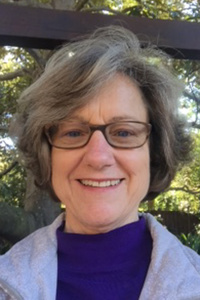
Jean F. Andrews
Jean F. Andrews, PhD, received a bachelor's degree in English language and literature from Catholic University, in Washington, DC, a master's in education in Deaf education from McDaniel College (formerly Western Maryland College) in Westminster, Maryland, and a doctorate in speech and hearing sciences from the University of Illinois, Champaign-Urbana, Illinois. Dr. Andrews was a classroom teacher of reading at the Maryland School for the Deaf in Frederick, Maryland. From 1983 to 1988, she prepared educational interpreters and teachers of Deaf students at Eastern Kentucky University, Richmond, Kentucky. From 1988 to 2015, she taught classes, prepared teachers and doctoral level leaders, and conducted applied research at Lamar University in Beaumont, Texas. Dr. Andrews' research interests include language and literacy, Deaf Studies, ASL/English bilingualism, and forensic issues with deaf offenders. She has also served on the governing board of the Texas School for the Deaf. Currently, she is working on ASL/English science materials for struggling Deaf readers.