
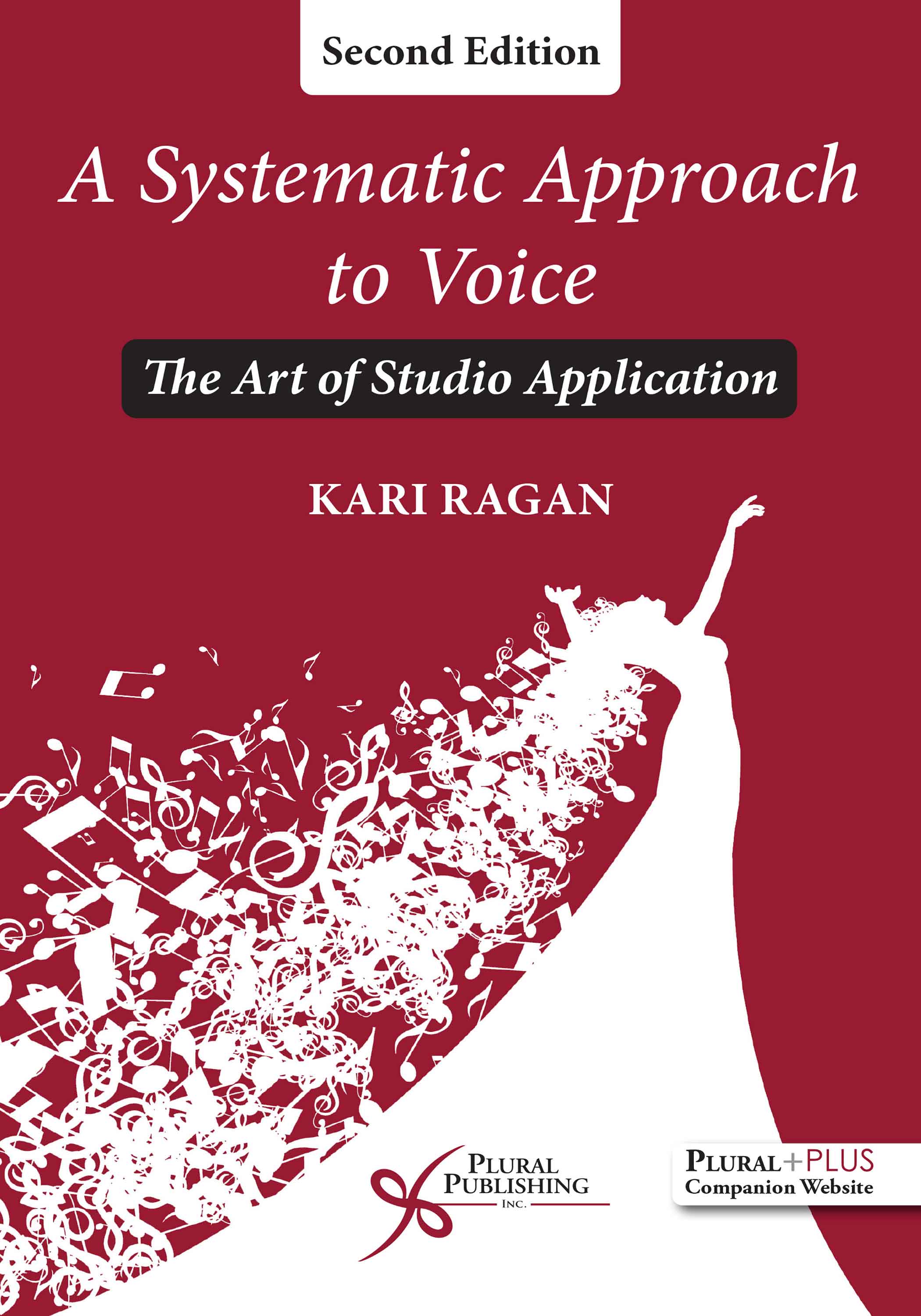
A Systematic Approach to Voice: The Art of Studio Application
Second Edition
Kari Ragan
Details: 475 pages, B&W, Softcover, 6" x 9"
ISBN13: 978-1-63550-778-2
© 2026 | Available
For Instructors
Purchase
A Systematic Approach to Voice: The Art of Studio Application, Second Edition is a flexible, enduring resource for voice teachers, coaches, speech pathologists, and singers. Grounded in current voice science, it offers a systematic framework for identifying technical challenges and choosing effective corrective strategies. Drawing on Dr. Kari Ragan’s years of pedagogic experience, the book organizes training through five interdependent voice systems—respiration, phonation, registration, articulation, and resonance—equipping teachers with a practical method for guiding singers toward more efficient coordination.
This expanded second edition adds new chapters that deepen the pedagogical framework and broaden its application, while substantial structural revisions provide greater clarity and accessibility. At the heart of the text is an extensive collection of corrective vocal exercises, presented with clear intent and cueing, so teachers and singers can choose strategies quickly and apply them successfully in the moment. The aim is technically reliable singing in service of artistry.
New to the Second Edition
- New chapters:
- “Evidence-Based Voice Pedagogy (EBVP): A Tripartite Framework”
- “Vocal Cool-Down: Principles and Practice”
- “Pop Singing: Musical Foundations”
- “The Transgender and Gender-Expansive Singer”
- “Motor Learning Theory Applied to Teaching Singing”
- Significantly expanded coverage of semi-occluded vocal tract exercises (SOVTEs), including a systematic approach to studio application
Key Features
- 100+ video demonstrations of the vocal exercises and sample warm-ups
- 100+ vocal exercises for studio application across contemporary and classical styles
- Brief mechanics overviews for each voice system, plus “key takeaways” that translate concepts into studio-ready priorities
- A systematic approach to SOVT selection and use in the studio
- Kinesthetic singing tools to support coordination and feedback
- Twelve vocal warm-up routines for contemporary and classical genres, adaptable to varied skill levels
PluralPlus Online Ancillaries
Videos
Reviews
“Bit by bit, putting it together,” as Stephen Sondheim has written—that’s what Kari Ragan’s book offers. Students, teachers, and ultimately audiences are in for a treat.This book will certainly expand their skill set, sharpen their knowledge, and answer the questions they most frequently ask.
—Joan Lader, Vocal Coach, Tony Award honoree
Contents
Preface
A Note About This Book
How This Book Is Organized
How to Navigate This Book
A Note on Redundancy
Contributors
Acknowledgments
About the Author
Chapter 1. A Systematic Approach to Voice
A Systematic Approach
The Art of Studio Application
Heuristic Model for Vocal Learning
Voice Habilitation
Introducing Habilitative Vocal Exercises (HVEs)
Vocal Warm-Up Versus Habilitative Vocal Exercises (HVEs)
Cross-Training the Voice Athlete
Kinesthetic Singing Tools
Summary
References
Selected Resources
Chapter 2. Evidence-Based Voice Pedagogy (EBVP): A Tripartite Framework
Introduction
Origins of Evidence-Based Medicine (EBM)
Introducing the Voice Research Component
Introducing the Voice Teacher Expertise and Experience Component
Introducing the Student Goals and Perspectives Component
Summary of EBVP Framework
Section II. Voice Research Component (with Lynn Maxfield)
Defining Research
Assessing Research
Sciences and Humanities
Hierarchy of Importance
Section III. Teacher Expertise and Experience Component (with Kenneth W. Bozeman)
Sources of Expertise
Interactions With Colleagues
Continuing Education
Section IV. Student Goals and Perspective Component (with Lynn Helding)
Humanistic Education
Preferences, Needs, and Goals
Goal Setting
Chapter Conclusion: EBVP Framework
References
Chapter 3. Respiration System
Foundations and Function
Inhalation
Exhalation
Key Takeaways
The Interdependence of Respiration and Phonation
The Impact of Vocal Style on Breath Management
Breath Management Across the Lifespan
Further Considerations on Breath Management
Application: Respiration—Habilitative Vocal Exercises (HVEs)
Embodied Breath and Movement
Large Ball: Spinal Release and Mobility
Large Ball: Seated Alignment
Sensory Breath Work
Nostril Occlusion for Breath Engagement
Alternate Nostril Breathing for Balance
Voiced and Unvoiced Breath Work
Sustaining Unvoiced Consonants
Rhythmic Patterns on Unvoiced Consonant
Alternating Unvoiced and Voiced Consonant Pairs
Flow-Ball Respiratory Training
Flow-Ball Airflow Awareness
Flow-Ball Voiceless Staccato
Flow-Ball Voiceless Messa di Voce
Flow-Ball Voiced “Flownation”
Breath Depletion and Recovery
Breath Depletion Prior to Inhalation
Breath Depletion Conditioning
Respiration and Resonance Coordination
/ʃum/ Coordination Patterns
Rib Cage Mobility and Mechanics
Dynamic Rib Cage Mobility
Exercise Band for Rib Cage Expansion
Restricted Chest Inhalation
Targeted Respiratory Release
Pelvic Floor Release
Lower Sternum Area Release
Core Engagement for Breath Coordination
Core Engagement Using Exercise Balls
Large Ball Flow Integration
Large Ball Wall Squat
Exercise Band Core Engagement
Knee Lift Core Activation
Summary
References
Chapter 4. Phonation System
Foundations and Function
Vocal Fold Structure
Vocal Fold Oscillation and Aerodynamics
Laryngeal Framework
Pitch and Frequency
Factors That Influence Pitch
The Role of the Vocal Tract in Phonation
Key Takeaways
Application: Phonation—Habilitative Vocal Exercises (HVEs)
Vocal Onsets
Mastering Staccato
Staccato–Legato Coordination
Laryngeal Anchoring
Thyrohyoid Gap Stabilizing Cue
Tactile Stretch for Laryngeal Stability
Vocal Fry
Vocal Fry Foundational Coordination
Vocal Fry Bridge to Chest Registration
Vocal Fry Bridge to Head Registration
Summary of Phonation
Section II. Semi-Occluded Vocal Tract Exercises (SOVTEs)
Foundations and Function (SOVTEs)
Key Takeaways for SOVTEs
Application: SOVTEs—Habilitative Vocal Exercises (HVEs)
Straw Phonation
Straw Diameter
Straw Length
Straw Material
Straw Phonation: How-To Basics
Straw Phonation Pitch Glides: Undulating Waves
Straw Phonation Pitch Glides: Range Expansion
Straw Phonation Pitch Glides: Progressive Intervals
Straw Phonation: Scalar Coordination
Straw Phonation: Bridging to Vowels
Lip Trills
Lip Trill: Arpeggio
Lip Trill: Chromatic Scale
Water Bubbles (Tube Submerged in Water)
Water Bubbles: Tube Diameter and Immersion Depth
Water Bubbles: Tube Length and Material
Water Bubbles: Kinesthetic Sensations of a Massage-like Effect
Water Bubbles: Practice Duration and Frequency
Water Bubbles: Choosing the Right Container
Water Bubble Pitch Glide
Water Bubble Repertoire
Acapella PEP Device
Acapella PEP Device: Effects on Vocal Function
Acapella PEP Device: Dry Bubbling Exercise
Puffy Cheeks
Puffy Cheeks Pharyngeal Wall and Oral Space Release
Nasal Resistance (NR) Technique
NR Technique: Introductory Exercise
NR Technique to Encourage Lofted Resonance
NR Technique for Developing a Mixed Voice Quality
Anesthesia Mask
Anesthesia Mask for Connected Speech in Singing
Summary of SOVTEs
Section III. A Systematic Approach to SOVTE Selection
Respiration and SOVTEs
Respiratory Challenges for SOVTE Selection
Respiration-Focused SOVTEs for Training
Registration and SOVTEs
Registration Challenges for SOVTE Selection
Registration-Focused SOVTEs for Training
Articulation and SOVTEs
Articulation Challenges for SOVTE Selection
Articulation-Focused SOVTEs for Training
Resonance and SOVTEs
Resonance Challenges for SOVTE Selection
Resonance-Focused SOVTEs for Training
Summary of a Systematic Approach to SOVTE Selection
References
Chapter 5. Registration System
Foundations and Function
Laryngeal Source Registration
Mode Versus Mechanism
Acoustic Registration
Physiological Variations in Registration Across Styles
Key Takeaways
The Importance of Cross-Training
Navigating Registration Terminology in Pedagogy
Application: Habilitative Vocal Exercises (HVEs)
Head Register Isolation: Sopranos, Altos, and Countertenors
Soft /u/—Secondo Passaggio
Sustained Head Register Isolation
Head Register Crescendo
Advanced Head Register Isolation
Bel Canto-Inspired Cadence Training
Head Register Isolation: Tenors, Baritones, and Basses
Soft /u/ for Strengthening Head Register
Head Register Isolation With Vowel and Volume Variations
Building a Bridge Across Registers
Head-to-Chest Transition for High Notes
Messa di Voce Through the Secondo Passaggio
Chest Register Isolation
Foundational Chest Register Isolation
Head Register to Facilitate Efficient Chest Register
Building a Bridge to Belting
Mixed Voice Quality: Strategies for a Broad Spectrum of Sound
“Meow” to Facilitate Mixed Registration
“Me-o” Resonance Flexibility
Dynamic Belt Spectrum
“My”—Seamless Mixed Registration
Articulatory Flexibility in Mixed Registration
Exploring Timbres: /Wæ/ Versus /Wo/
Ode to Joan Lader
Register Alternation Drill
Ghostlike Vocalization
Yodel for Register Balance
Mastering Messa di Voce
Summary
References
Chapter 6. Articulation System
Foundations and Function
Jaw
Tongue
Soft Palate
Pharynx
Key Takeaways
Application: Articulation—Habilitative Vocal Exercises (HVEs)
Jaw Stretches
Jaw Circular Motion
Chewing for Jaw Mobility
Jaw Stretch With Lip Retraction
Masseter Muscle Massage
Temporalis Muscle Release
Jaw Voiced Exercises
Wine Cork Between Front Teeth
Wine Cork Between Molars
Masseter Muscle Release
Tongue Stretches
Tongue Extension Stretch
Tongue Curl Stretch
Underside Extension Stretch
Circular Tongue Stretch
Tongue–Jaw Release Stretch
Tongue Voiced Exercises
Dental Consonants
Palatal Consonants
Jaw and Tongue Independence
Raspberry and Tongue Trills
Tongue and Floor of Mouth Awareness
Candy on the Tongue
Gauze on the Tongue
Tongue Exploration With Gauze Finger Cots
Ode to Barbara Doscher
Dental and Palatal Consonant Combinations
Pigeon
Puffy Cheeks With Words
Soft Palate Stretches
Mapping Soft Palate Activation
Soft Palate Voiced Exercises
Varying Soft Palate Elevation on /ha/
Nasality for Soft Palate Coordination
Thumb Feedback for Soft Palate Awareness
Summary
References
Chapter 7. Resonance System
Foundations and Function
The Acoustics of Vocal Ring
The Singer’s Formant Cluster (SFC) in Classical Singing
Contemporary Singer’s Twang
Comparing Resonance in Western Classical and Contemporary Singing
Key Takeaways
Application: Habilitative Vocal Exercises (HVEs)
Chant Speech Into Humming
Hands-On Sensory Mapping
Pitch Glides Into Humming
Stabilizing Resonance Through Humming
Resonance Mapping With “Rum”
Resonance Shaping With “Yummy”
Ode to Ellen Faull
Zing for Resonance Strategy
Resonance Mapping With /m/ and Vowels
Leaning Into Resonance
Releasing Into Resonance: Lying Over a Ball
Resonance Shaping With a Chopstick
Chadley Ballantyne’s “Weird” /ɻ/
Y-Buzz: Adapting Lessac’s Approach for Singing
Twang Strategies for Brassy Resonance
Vowel Mapping for Resonance
Summary
References
Chapter 8. Vocal Warm-Up Routines
Introduction
Classical: Soprano, Alto, and Countertenor (Early)
Classical: Soprano, Alto, and Countertenor (Intermediate)
Classical: Soprano, Alto, and Countertenor (Advanced)
Classical: Tenor, Baritone, and Bass (Early)
Classical: Tenor, Baritone, and Bass (Intermediate)
Classical: Tenor, Baritone, and Bass (Advanced)
Contemporary: Soprano, Alto, and Countertenor (Early)
Contemporary: Soprano, Alto, and Countertenor (Intermediate)
Contemporary: Soprano, Alto, and Countertenor (Advanced)
Contemporary: Tenor, Baritone, and Bass (Early)
Contemporary: Tenor, Baritone, and Bass (Intermediate)
Contemporary: Tenor, Baritone, and Bass (Advanced)
Chapter 9. Vocal Cool-Downs: Principles and Practice
Foundations and Function
Rationale for a Vocal Cool-Down
Key Considerations
Vocal Cool-Down Regimen
Summary
References
Other Resources
Chapter 10. Pop Singing: Musical Foundations
Jordyn Day
Introduction
Amplification, Genre Stylisms, and Learning Through Listening
Musical Foundations
Pentatonic Scale
Blues Scales
Scales in Harmonic Context
Agility
Agility and the Pentatonic Scale
Agility and Pentatonic Progressions
Rhythm
Application: Pop Singers—Habilitative Vocal Exercises (HVEs)
Respiration: Considerations for the Pop Singer
Phonation: Considers for the Pop Singer
Vocal Fry: Sustained Tone Onset
Breathy Onset
Breathy Onset: Sustained Tone
Breathy to Balanced: Messa di Voce
Registration: Considerations for Pop Singers
Yodels
Pentatonic With Register Transitions
Head to Chest Vowel Shaping: Messa di Voce
Scoop Pulse Registration
Articulation: Considerations for the Pop Singer
Diphthongs for Style and Expression
Single-Note Diphthong Slide
Percussive Consonants on Triplets
Resonance: Considerations for Pop Singers
Exploring Resonance With Closed Lips and Words
/ng/ to /ŋ/
Added Nasalance in Quick-Moving Passages
Summary
References
Chapter 11. The Transgender and Gender-Expansive Singer
Jae C. Bernado and Emerald Lessley
Introduction and History
Creating a Welcoming Environment for TGE Singers
Language
Trauma-Informed Practice
Neurodiversity-Affirming Practice
Collaborative Goal Setting
Changing the Keys of Songs
Hormones and Voice
Testosterone
Estrogen and Progesterone
Key Takeaways: Working With TGE Singers
Application: TGE Singers—Habilitative Vocal Exercises (HVEs)
Respiration: Adaptations for TGE Singers
Alternating Unvoiced and Voiced Consonant Pairs
Phonation: Adaptations for TGE Singers
Straw Phonation Pitch Glides: Progressive Intervals
Straw Phonation: Bridging to Vowels
Registration: Adaptations for TGE Singers
Soft /u/: Secondo Passaggio
Head-to-Chest Transition for High Notes
Articulation: Adaptations for TGE Singers
Dental and Palatal Consonant Combinations
Resonance: Adaptations for TGE Singers
Chant Speech Into Humming
Y-Buzz: Adapting Lessac’s Approach for Singing
Vowel Mapping for Resonance
Summary
References
Chapter 12. Motor Learning Theory Applied to Teaching Singing
Lynn Maxfield
The Foundation of Motor Learning in Voice Pedagogy
Phases of Motor Skill Development
An Ecological Approach to Motor Learning in Singing
Understanding and Applying Augmented Feedback
Inherent Versus Augmented Feedback
Know What or Know How
The Multiple Roles of Augmented Feedback
Feedback Timing and Frequency
Feedback Frequency: How Often?
Feedback Timing: When?
Optimizing Feedback Content and Precision
Describing or Prescribing
When Precision Overwhelms
Less Precise Does Not Mean Unfounded
Student Motivation and Self-Efficacy in Vocal Learning
Facilitating Self-Efficacy
Positive Peer Comparison
Promoting Autonomy and Agency
Autonomy Fuels Effective Learning
More on Structuring Practice
Distributed Versus Massed Practice
Transfer of Learning and Performance in Real Contexts
Best Practices for Systematic Voice Teaching With Motor Learning in Mind
Summary
References

Kari Ragan
Kari Ragan, DMA, MM, BM, is an internationally recognized voice pedagogue and Singing Voice Rehabilitation Specialist (SVRS) with a career spanning more than four decades. She is known for her commitment to applying voice science in service of artistic expression—a guiding principle that has shaped her work with singers across genres and career stages. Dr. Ragan earned her Doctor of Musical Arts from the University of Washington (2005) and both a Master and Bachelor of Music in Vocal Performance from the Indiana University Jacobs School of Music. She received the Van L. Lawrence Fellowship in 2012, was named a Master Teacher for the NATS Intern Program in 2021, and was inducted into the American Academy of Teachers of Singing in 2025. From 2010 to 2021, she served on the voice faculty at the University of Washington and has maintained a vibrant independent voice studio since 1983. Working in affiliation with the University of Washington’s laryngology program, Dr. Ragan collaborates with a multidisciplinary voice team to support singers recovering from vocal injury or pathology and partners with voice clinics throughout the United States to help rehabilitate injured voices. An active presenter and educator, Dr. Ragan is frequently invited to give workshops and lectures for voice organizations and academic institutions nationally and internationally. She has presented for NATS, the Pan American Vocology Association (PAVA), The Voice Foundation, the International Congress of Voice Teachers (ICVT), and many others. Dr. Ragan is the co-founder and organizer of the multi-disciplinary Northwest Voice: The Art and Science of the Performing Voice Conference. Since 2011, she has also served as moderator of the popular NATS Chat series.
A Systematic Approach to Voice: The Art of Studio Application, Second Edition comes with access to supplementary student and instructor resources on a PluralPlus companion website.
The companion website is located at: https://www.pluralpublishing.com/publication/sav2e
SUPPLEMENTARY RESOURCES:
The student resources include Videos.
To access the student resources, you must register on the companion website and log in using the access code located in the front of your textbook.
*Note for students: If you have purchased this textbook used or have rented it, your access code will not work if it was already redeemed by the original buyer of the book. Plural Publishing does not offer replacement access codes for used or rented textbooks.