
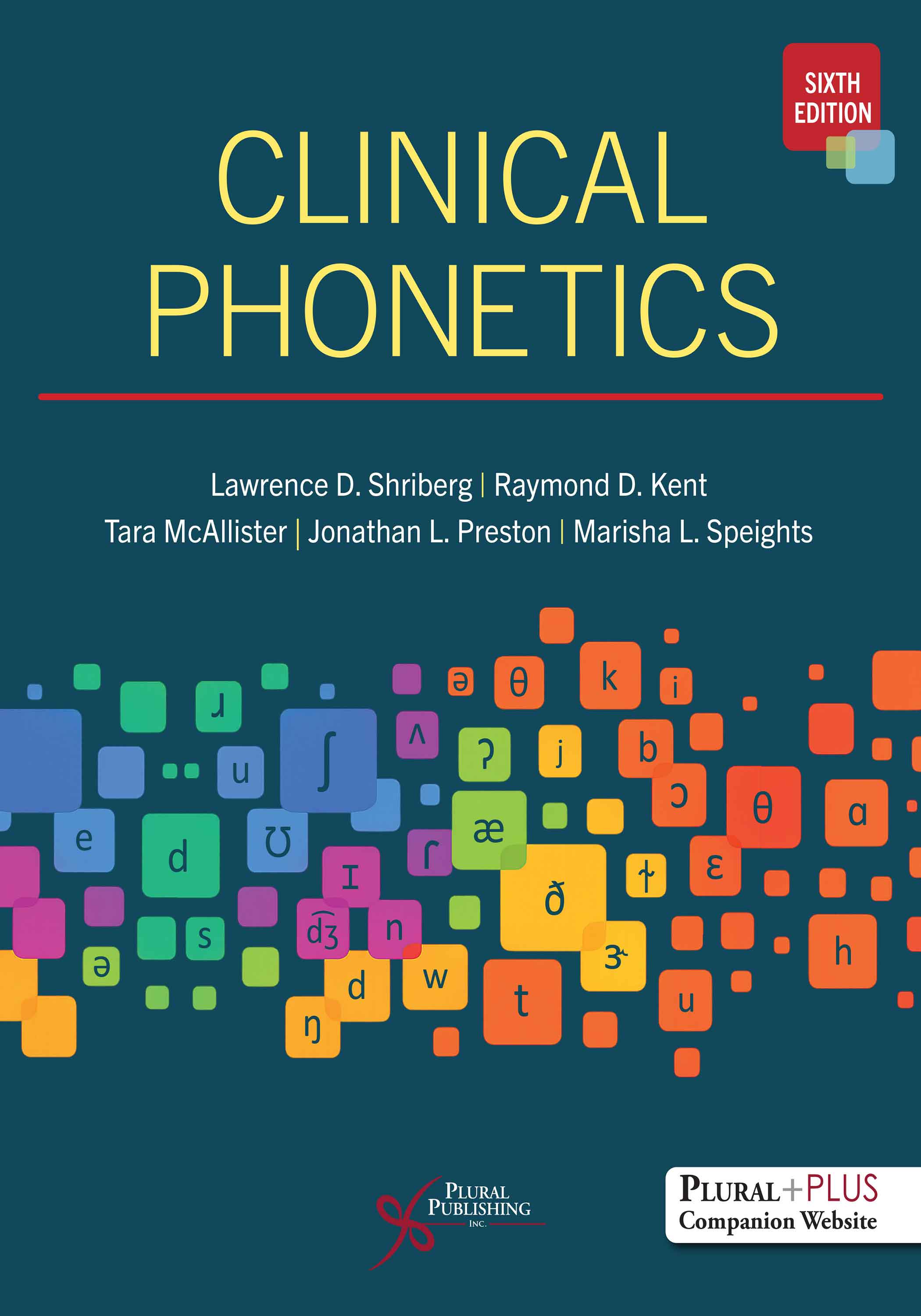
Clinical Phonetics
Sixth Edition
Lawrence D. Shriberg, Raymond D. Kent, Tara McAllister, Jonathan L. Preston, Marisha L. Speights
Details: 431 pages, 2-Color, Softcover, 8.5" x 11"
ISBN13: 978-1-63550-761-4
© 2027 | Available
For Instructors
Purchase
Now Published by Plural!
The sixth edition of the classic textbook, Clinical Phonetics, continues to serve as both a practical guide and a thought-provoking reflection on the evolving landscape of phonetics in speech-language pathology. It provides articulatory descriptions and transcription guidance for the basics of American English phonetics, while also showcasing the diversity of phonetic forms that students will encounter across speakers with varied linguistic and clinical characteristics. This edition takes a more integrative approach than previous ones, highlighting how language backgrounds, community contexts, and clinical decision-making intersect throughout the chapters.
One of the most significant updates in this edition is a new opening discussion on how linguistic characteristics vary among speakers and why these differences matter in clinical practice—a topic students consistently find engaging and relevant. These concepts are revisited across multiple chapters to support integrated learning and to emphasize key considerations for applying phonetics in clinical settings. The updates to the text are designed to equip students with the knowledge, skills, and awareness needed to become effective, responsive clinicians who can confidently and accurately transcribe speech in all its rich and meaningful variation.
New to the Sixth Edition
- New and expanded audio materials using voices that reflect a range of ages, genders, and racial and cultural backgrounds, ensuring that the speech samples used for transcription practice better represent the populations students are likely to encounter in clinical work.
- Transcription conventions aligned with the International Phonetic Alphabet, including modifications to some core symbols (for instance, /ɹ/ instead of /r/), diacritics, and conventions for marking stress.
- Chapter 5 on consonant transcription is reorganized by manner rather than place of articulation in order to help students better understand natural classes that underlie phonological patterns.
- To help students tackle the challenge of narrow transcription, one chapter has been divided into two:
- Chapter 7 focuses on typical allophonic variation.
- Chapter 8 addresses clinical deviations. The clinical speech transcription exercises in this chapter are reorganized to start with changes that are easier to transcribe, like stop substitutions, and progress to more challenging deviations like vowel distortions.
- Completely new or revised illustrations throughout the text, depicting the important features of individual speech sounds.
Key Features
- Phonetic diversity highlighted throughout the book
- Emphasis on transcription of clinically relevant variation in speech
- Hundreds of transcription exercises to build students’ perception and transcription of American English speech sounds
- Thousands of audio examples representing child and adult speakers
- Images and videos to support students’ understanding of articulatory and acoustic phonetics
PluralPlus Online Ancillaries
For instructors: PowerPoint Slides, Test Bank, Chapter Quizzes with Answers
For students: Audio Examples and Exercises, Videos, Transcription Sheets, Transcription Training Keys, Chapter Quizzes with Answers, and eFlashcards
Learn more about the authors' input on the history and future of phonetic transcription on the Plural Blog.
Contents
Preface
Acknowledgments
About the Authors
Chapter 1. Introduction to Phonetics and Phonetic Variation
Phonetics and Phonetic Variation
The Study of Language Variation
Sources of Phonetic Variation
Is There a “Standard” Variety?
Considerations of Age and Gender
Language Variation and Clinical Practice
The Importance of Sound Files
Conclusion
Chapter Summary Exercises
Chapter 2. Phonetics and Language
The Phoneme
The International Phonetic Alphabet (IPA)
Phonetics and Phonology
The Syllable
Stressed and Unstressed Syllables
Positional and Contextual Terminology for Phonetic Descriptions
The Morpheme
Phonological Awareness
Markedness
Quantitative Linguistics
Conclusion
Chapter Summary Exercises
Chapter 3. The Anatomy and Physiology of Speech Production
The Respiratory System
The Laryngeal System
The Supralaryngeal System
The Jaw
The Tongue
The Lips
The Teeth
Variation in Vocal Tract Anatomy
Speech Motor Control
Technologies for the Study of Phonetics
X-ray Imaging
Magnetic Resonance Imaging (MRI)
Electromagnetic Articulography (EMA)
Ultrasound Imaging
Electropalatography (EPG)
Fiber-optic Endoscopy
Aerodynamic Analysis
Acoustic Analysis
Conclusion
Chapter Summary Exercises
Chapter 4. Vowels: Monophthongs and Diphthongs
Introduction
Vowel Articulation
Tongue Height (the High–Low Dimension of Tongue Position)
Tongue Advancement (the Front-Back Dimension of Tongue Position)
Tense versus Lax Vowels
Exercise: Is the Vowel Tense or Lax?
Lip Configuration (Rounding)
Exercise: Is the Vowel Rounded or Unrounded?
Vowel Description: Tongue Height, Tongue Advancement, Tenseness, and Lip Rounding
Lateral Tongue Bracing
Nasalization
The Front Vowels
Vowel /i/ (He)
Articulatory Description: High, Front, Tense, and Unrounded Vowel
Transcription Words
Vowel /ɪ/ (Hid)
Articulatory Description: High-Mid, Front, Lax, and Unrounded Vowel
Transcription Words
Vowel /e/ (Say)
Articulatory Description: Mid, Front, Tense, and Unrounded Vowel
Transcription Words
Vowel /ɛ/, Sometimes Called “Epsilon” (Head)
Articulatory Description: Low-Mid, Front, Lax, and Unrounded Vowel
Transcription Words
Vowel /æ/, Sometimes Called “Ash” (Had)
Articulatory Description: Low, Front, Lax, and Unrounded Vowel
Transcription Words
The Back Vowels
Vowel /u/ (Who)
Articulatory Description: High, Back, Tense, and Rounded Vowel
Special Considerations
Transcription Words
Vowel /ʊ/, Sometimes Called “Upsilon” (Hook)
Articulatory Description: High-Mid, Back, Lax, and Rounded Vowel
Transcription Words
Vowel /o/ (Boat)
Articulatory Description: Mid, Back, Tense, and Rounded Vowel
Transcription Words
Vowel /ɔ/, Sometimes Called “Open o” or “Backwards c” (Hall)
Articulatory Description: Low-Mid, Back, Tense, and Rounded Vowel
Transcription Words
Vowel /ɑ/, Sometimes Called “Script a” (Hot)
Articulatory Description: Low, Back, Tense, and Unrounded Vowel
Transcription Words
The Central Vowels and Rhotic Vowels
Vowel /ʌ/, Sometimes Called “Turned V,” “Wedge,” or “Caret” (Hub)
Articulatory Description: Low-Mid, Back-Central, Lax, and Unrounded Vowel
Transcription Words
Vowel /ə/, Sometimes Called “Schwa” (first syllable in Above)
Articulatory Description: Mid-Central, Lax, and Unrounded Vowel
Transcription Words
Vowel /ɝ/), Sometimes Called “Stressed Schwar” (Her)
Articulatory Description: Mid-Central, Tense, and Rounded Vowel
Transcription Words
Vowel /ɚ/, Sometimes Called “Schwar” (Mother)
Articulatory Description: Mid-Central, Lax, and Rounded Vowel
Transcription Words
Transcription Words with Both Stressed /ɝ/ and Unstressed /ɚ/
Other Vowels with R-Coloring
R-Colored Vowel /ɑɹ/ (Far)
Articulatory Summary for /ɑɹ/
Transcription Words
R-Colored Vowel /ɔɹ/ (Four)
Articulatory Summary for /ɔɹ/
Transcription Words
R-Colored Vowel /ɪɹ/ (Fear)
Articulatory Summary for /ɪɹ/
Transcription Words
R-colored Vowel /ɛɹ/ (Fair)
Articulatory Summary for /ɛɹ/
Transcription Words
Cardinal Vowels
Three-Dimensional Grid of Vowel Production in American English
Diphthongs
Phonemic and Nonphonemic Diphthongs
Phonemic Diphthongs
Diphthong /a͡ɪ/ (Bye; Figure 4-23)
Articulatory Summary for /a͡ɪ/
Transcription Words
Diphthong /ɔ͡ɪ/ (Boy; Figure 4-23)
Articulatory Summary for /ɔ͡ɪ/
Transcription Words
Diphthong /a͡ʊ/ (Bough; Figure 4-23)
Articulatory Summary for /a͡ʊ/
Transcription Words
Nonphonemic Diphthongs
Exercise: Identifying Diphthongs
Allographs of the Vowel Phonemes of English
Vowels Around the World
The Many Roles of Vowels
The Acoustic Properties of Vowels
The Vocal Tract as a Resonator
The Spectrum and Spectrogram
Vowel Formant Patterns
Applications of Vowel Acoustics
Effects of Language and Dialect on Vowel Acoustics
Conclusion
Chapter Summary Exercises
Chapter 5. Consonants
Manner of Articulation
Stops
Stops—Articulatory Summary
Fricatives
Fricatives—Articulatory Summary
Affricates/
Affricates—Articulatory Summary
Nasals
Nasals—Articulatory Summary
Liquids
Liquids—Articulatory Summary
Glides
Glides—Articulatory Summary
Place of Articulation
The Voicing Feature
Consonants by Manner, Place, and Voicing
Transcribing Stop Consonants
Bilabial Stops: /b/ and /p/
Alveolar Stops: /t/ and /d/
Alveolar Flap: [ɾ]
Velar stops: /k/ and /ɡ/
Glottal stop: [ʔ]
Transcribing Fricative and Affricative Consonants
Labiodental Fricatives: /f/ and /v/
Interdental (or Dental) Fricatives: /θ/ and /ð/
Alveolar Fricatives: /s/ and /z/
Palatal Fricatives: /ʃ/ and /ʒ/
Glottal Fricative: /h/
Palatal Affricates: /t͡ʃ/ and /d͡ʒ/
Transcribing Nasal Consonants
Bilabial Nasal: /m/
Alveolar Nasal: /n/
Velar Nasal: /ŋ/
Transcribing Liquid Consonants
Alveolar Lateral Liquid: /l/
Palatal Rhotic Liquid: /ɹ/
Transcribing Glides
Labiovelar Glide: /w/
Palatal Glide: /j/
Frequency of Occurrence of Place of Consonant Articulation
Summary Classification of Consonants in American English
Consonant Acoustics
Acoustic Features of Consonant Classes
Stops
Fricatives
Affricates
Nasals
Liquids
Glides
Effects of Speaker Age and Sex on Consonant Acoustics
Sounds in Sequence
Conclusion
Chapter Summary Exercises
Chapter 6. Suprasegmentals and Prosody
The Units of Prosody
Syllables
Phonemes within Syllables
The Prosodic Foot
The Intonational Phrase
Intonation
Stress
Lexical Stress
Lexical Stress Marking in the IPA
Reduction
Stress Beyond the Word Level
Contrastive Stress
New versus Given Information
Rhythm and Timing
Rhythm
Timing
Juncture
Pause
Boundary or Edge Effects
Symbols to Mark Timing, Juncture, and Intonation
Lengthened [siː]
Shortened [wĭ]
Close Juncture [la͡ɪtha͡ʊs]
Open Juncture [ənaɪs+mæn] versus [ən+aɪsmæn]
Internal Open Juncture [hɛlpǀsu]
Falling Terminal Juncture [tudeɪꜜ]
Rising Terminal Juncture [tudeɪꜛ]
Checked or Held Juncture [tudeɪ→]
Selected Extensions to the International Phonetic Alphabet
Paralinguistics
Registers
Infant-Directed Speech
Clear Speech
Other Prosodic Variations
Dialectal Variation of Prosody
Prosody in Typical and Atypical Development of Speech and Language
Clinical Assessment of Prosody
Crystal’s Prosody Profile (PROP)
Shriberg, Kwiatkowski, and Rasmussen’s Prosody-Voice Screening Profile (PVSP)
Profiling Elements of Prosodic Systems—Child Version (PEPS-C)
An Integrated View of Suprasegmentals
Conclusion
Chapter Summary Exercises
Chapter 7. Narrow Transcription
Phonemes and Allophones
Uses of Narrow Transcription
Coarticulation
Diacritics Used to Represent Coarticulation
Nasal Symbols
Nasalized [mæ̃n]
Lip Symbols
Labialized Consonant [kʷwin]
Tongue Symbols
Dentalized [wɪd̪θ]
Palatalized [sʲtɹit]
Velarized [fiɫ]
Fronted or Advanced [k̟ɪt]
Retracted [s̠tɹit]
Voice-Related Symbols
Partially Voiced [æbs̬ɪnt]
Partially Devoiced [dɔɡ̥]
Glottalized (or Creaky Voice) [bɑ̰ks]
Breathy (or Murmured) [pli̤z]
Stop Release Symbols
Aspirated [tʰɑp]
Unaspirated [st=ɑp]
Unreleased [lip̚]
Syllabic Symbol
Conclusion
Chapter Summary Exercises
Chapter 8. Practicing Broad and Narrow Transcription of Children’s Speech
Introduction
Diacritics for Clinical or Developmental Variation
Preparing to Practice Clinical Transcription
Part A: Transcription of Stop Sound Changes
Training Modules: Stops
Stops Module 1: Stop Substitutions
Stops Module 2: Stop Deletions
Stops Module 3: Glottal Stop Substitutions
Stops Module 4: Voicing of Voiceless Stops
Stops Module 5: Devoicing of Voiced Stops
Stops Module 6: Frictionalized Stops
Stops Module 7: Summary Quiz
Part B: Transcription of Fricative and Affricate Sound Changes
Description of Fricatives
Distribution and Frequency of Occurrence of Fricatives and Affricates
Training Modules: Fricatives and Affricates
Overview
Stopping
Place Substitutions
Deletions
Voicing Changes
Distortions
Summary
Fricatives and Affricates Module 1: Nonsibilant Fricative Substitutions
Fricatives and Affricates Module 2: Sibilant Fricative and Affricate Substitutions
Fricatives and Affricates Module 3: Fricative Deletions
Fricatives and Affricates Module 4: Fricative and Affricate Voicing Changes
Fricatives and Affricates Module 5: Dentalized Sibilants
Fricatives and Affricates Module 6: Lateralized Sibilants
Fricatives and Affricates Module 7: Palatalized Sibilants
Whistled (or Hissed)
Fricatives and Affricates Module 8: Sibilants Quiz
Fricatives and Affricates Module 9: Summary Quiz
Part C: Transcription of Glide and Liquid Changes
Description of Glides and Liquids
Distribution and Frequency
Training Modules: Glides and Liquids
Glides and Liquids Module 1: Glide Changes
Glides and Liquids Module 2: /l/ Substitutions
Glides and Liquids Module 3: Velarized /l/
Trilled rhotic /r/
Glides and Liquids Module 4: Derhotacized /ɹ/, /ɝ/, /ɚ/
Derhotacized [ɹ̮ɛd]
Glides and Liquids Module 5: Velarized /ɹ/
Glides and Liquids Module 6: /ɹ/ Quiz
Glides and Liquids Module 7: Summary Quiz
Part D: Transcription of Nasal Sound Changes
Training Modules: Nasals
Nasals Module 1: Nasal Deletions
Nasals Module 2: Summary Quiz
Part E: Transcription of Vowel Sound Changes
Training Modules: Vowels
Vowels Module 1: Vowel Substitutions
Vowels Module 2: Vowel Modifications
Rounded and Unrounded Production [swi̹t]; [du̜d]
Fronted/Advanced and Backed/Retracted Production [hɑ̟t]; [sæ̠d]
Raised and Lowered Production[sɛ̝t]; [bɛ̞d]
Vowels Module 3: Central Vowels
Vowels Module 4: Vowel Substitutions, Modifications, and Central Vowels
Vowels Module 5: Vowel Additions
Vowels Module 6: Vowel Lengthening [biːd]
Vowels Module 7: Vowel Nasalization
Vowels Module 8: Summary Quiz
Other Symbols used in Clinical Transcription
Synchronic Tie
Unintelligible Syllable
Questionable Segment
Grand Quiz
Chapter 9. Preparing to Collect and Transcribe Clinical Speech Samples
Eliciting and Recording Speech Samples
Recording Equipment
Microphones
Digital Recording Options
The Recording Environment
Eliciting the Sample
Factors that Influence Scoring and Transcription
Client Factors
Age and Behavior
Individual Speaking Characteristics
Intelligibility
Phonetic Variation
Task Factors
Linguistic Context
Response Requirements
Judgment Bias
Approaches to Clinical Transcription and Scoring
Transcription and Scoring Systems
What Level of Detail Should Be Represented?
Broad versus Narrow Transcription
How Much of the Data Should Be Transcribed Live versus Transcribed Later from Audio or Video Recordings?
The Process of Scoring or Transcription
Should I Use Video Recording?
Should I Use Headphones?
Should I Preview the Recording?
What if I’m Not Sure What I’m Hearing?
How Many Times Should I Listen?
What Are Some Strategies for Difficult Words?
Some Final Suggestions
Conclusion
Chapter 10. Phonetics in the Clinical Setting
Single-Word Tests of Articulation and Phonology
Transcribing Nonwords
Two-Way Scoring and Deep Testing
Two-Way Scoring in Larger Speech Samples
Rating /s/ in Continuous Speech
Rating Rhotics in Continuous Speech
Transcription in Larger Speech Samples
Transcribing Imitated Phrases
Transcribing Read Sentences
Transcribing All Sounds in Continuous Speech
Transcribing Children with Motor Speech Disorders
Motor Speech Disorders: Imitated Single Words
Motor Speech Disorders: Imitated Words in Phrases
Motor Speech Disorders: Imitated Sentences
Motor Speech Disorders: Conversational Speech
Conclusion
Chapter 11. Transcribing Phonetic Variation
Introduction
Part A: Transcribing Regional Variation in American English
Southern American English
Location
Major Features
Western American English
Location
Major Features
Midland American English
Location
Major Features
Northern American English
Location
Major Features
Northeastern Varieties of American English
Location
Major Features
Practice Discriminating Regional Variation in Vowels
Regional Variation in Consonants
Socioprosodics
International Englishes
Part B: African American English
Origins of AAE
Clinical and Educational Considerations
Major Features of AAE
Part C: Transcribing Multilingual Speakers
Working with Speakers from Unfamiliar Language Backgrounds
Transfer from Spanish to English
Features of Spanish-influenced English
Conclusion
Further Reading
Online Resources
Transcription Trainings
Appendices
Appendix A-1. The International Phonetic Alphabet (Revised to 2020)
Appendix A-2. extIPA Symbols for Disordered Speech
Appendix B-1. Proportional Occurrence of Vowels in American English for Adults and Children
Appendix B-2. Proportional Occurrence of Consonant Phonemes in the Speech of Adults and Children
Glossary
Answers to Chapter Summary Exercises
References
Index

Raymond D. Kent
Raymond D. Kent, PhD, is Professor Emeritus of Communicative Sciences and Disorders at the University of Wisconsin–Madison. His publications include more than 250 journal articles, book chapters, and reviews on various topics in speech science and speech pathology. He has authored or edited 18 books, including: Clinical Phonetics, Intelligibility in Speech Disorders, Reference Manual for Communicative Sciences and Disorders: Speech-Language Pathology, The Speech Sciences, Handbook of Voice Quality Measurement, The MIT Encyclopedia of Communication Disorders, and Handbook on Children’s Speech: Development, Disorders, and Variations. He served as editor of the Journal of Speech and Hearing Research, associate founding editor of Clinical Linguistics and Phonetics, and associate editor of Folia Phoniatrica et Logopaedica. His awards include Honors of the American Speech-Language-Hearing Association; Docteur Honoris Causa from Université de Montréal; Honorary Professor, The University of Queensland, Australia; Visiting Erskine Fellow, University of Canterbury, New Zealand; and an Honorary Doctorate from the University of Oulu, Finland.

Tara McAllister
Tara McAllister, PhD, is an Associate Professor of Communicative Sciences and Disorders at New York University. She has published over 70 peer- reviewed papers spanning the disciplines of linguistics and speech-language pathology. Her research aims to understand how speech skills are acquired in both typical and clinical populations, and why developmental speech patterns resolve in some individuals but persist in others. She also directs the BITS (Biofeedback Intervention Technology for Speech) Lab at NYU, which develops and tests tools to provide visual biofeedback for persistent speech sound errors in children.

Jonathan L. Preston
Jonathan L. Preston, PhD, is a Professor of Communication Sciences and Disorders at Syracuse University and is a Fellow of the American Speech- Language-Hearing Association. He has coauthored numerous publications focusing on phonetic, phonological, and neurobiological characteristics of children with speech sound disorders. In his current position, he teaches coursework on phonetics and speech sound disorders, and he conducts clinical research on assessment and treatment of speech sound disorders, including residual speech errors and childhood apraxia of speech.

Marisha L. Speights
Marisha Speights, PhD, is an Assistant Professor of Communication Sciences and Disorders at North- western University. A speech-language pathologist and pediatric speech scientist, her research focuses on articulatory and acoustic phonetics, child speech production, and early detection of speech disorders. She directs the Pediatric Speech Technologies and Acoustics Research Lab, which uses large-scale speech data, acoustic analysis, and artificial intelligence (AI) to develop scalable tools for automated screening and assessment. Her work bridges clinical practice and technology to improve access to speech and language services for young children. She has taught phonetics and pediatric speech sound disorders for over a decade, and her publications in journals such as PLOS Digital Health, Journal of the Acoustical Society of America, and Clinical Linguistics and Phonetics feature tools for phonetic transcription and automated analysis of child speech.
Clinical Phonetics, Sixth Edition comes with access to supplementary student and instructor resources on a PluralPlus companion website.
The companion website is located at: https://www.pluralpublishing.com/publication/cp6e
STUDENTS:
The student resources include Audio Examples and Exercises, Videos, Transcription Sheets, Transcription Training Keys, Chapter Quizzes with Answers, and eFlashcards.
To access the student resources, you must register on the companion website and log in using the access code located in the front of your textbook.
INSTRUCTORS:
The instructor resources include PowerPoint Slides, Test Bank, Chapter Quizzes with Answers. You will also have access to all of the student resources listed above.
To access the instructor resources, you must contact Plural Publishing, Inc. to be verified as an instructor and receive your access code.
Email: instructormaterials@pluralpublishing.com
Tel: 866-758-7251 (toll free) or 858-492-1555
*Note for students: If you have purchased this textbook used or have rented it, your access code will not work if it was already redeemed by the original buyer of the book. Plural Publishing does not offer replacement access codes for used or rented textbooks.
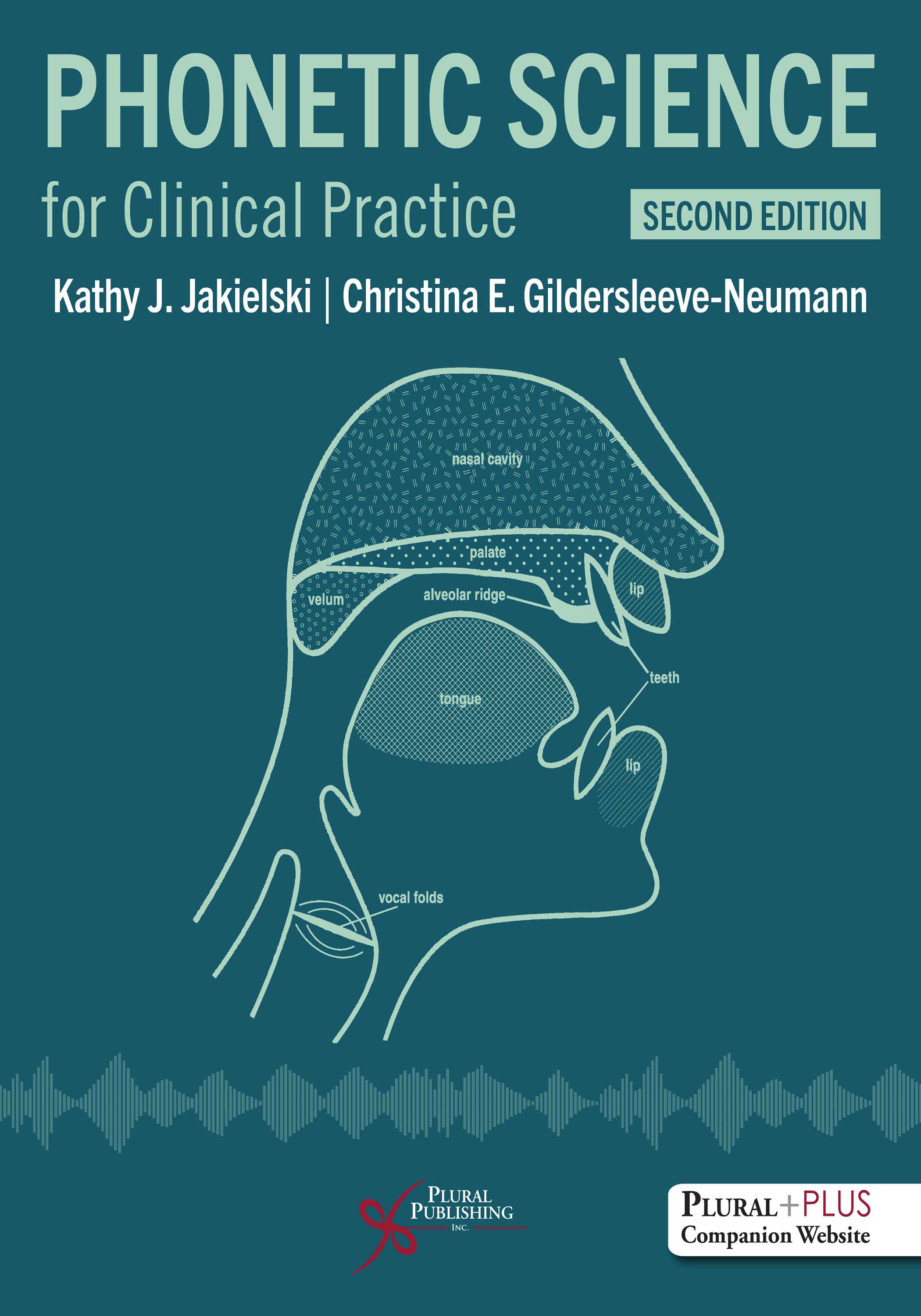
Phonetic Science for Clinical Practice
Second Edition
Kathy J. Jakielski, Christina Gildersleeve-Neumann
Details: 327 pages, Two-Color, Softcover, 8.5" x 11"
ISBN13: 978-1-63550-405-7
© 2025 | Available
Phonetic Science for Clinical Practice: A Transcription and Application Workbook
Second Edition
Kathy J. Jakielski, Christina Gildersleeve-Neumann
Details: 378 pages, Two-Color, Spiral, 8.5" x 11"
ISBN13: 978-1-63550-407-1
© 2025 | Available
Functional Phonetics Workbook
Fourth Edition
Mary Lou Marsoun Cancio, Sadanand Singh, Brooke R. Findley
Details: 361 pages, B&W, Spiral Bound, 8.5" x 11"
ISBN13: 978-1-63550-594-8
© 2026 | Available
Acoustic Methods for Speech Science
First Edition
Raymond D. Kent, Ferenc Bunta
Details: 395 pages, B&W, Softcover, 7" x 10"
ISBN13: 978-1-63550-790-4
© 2027 | Available