
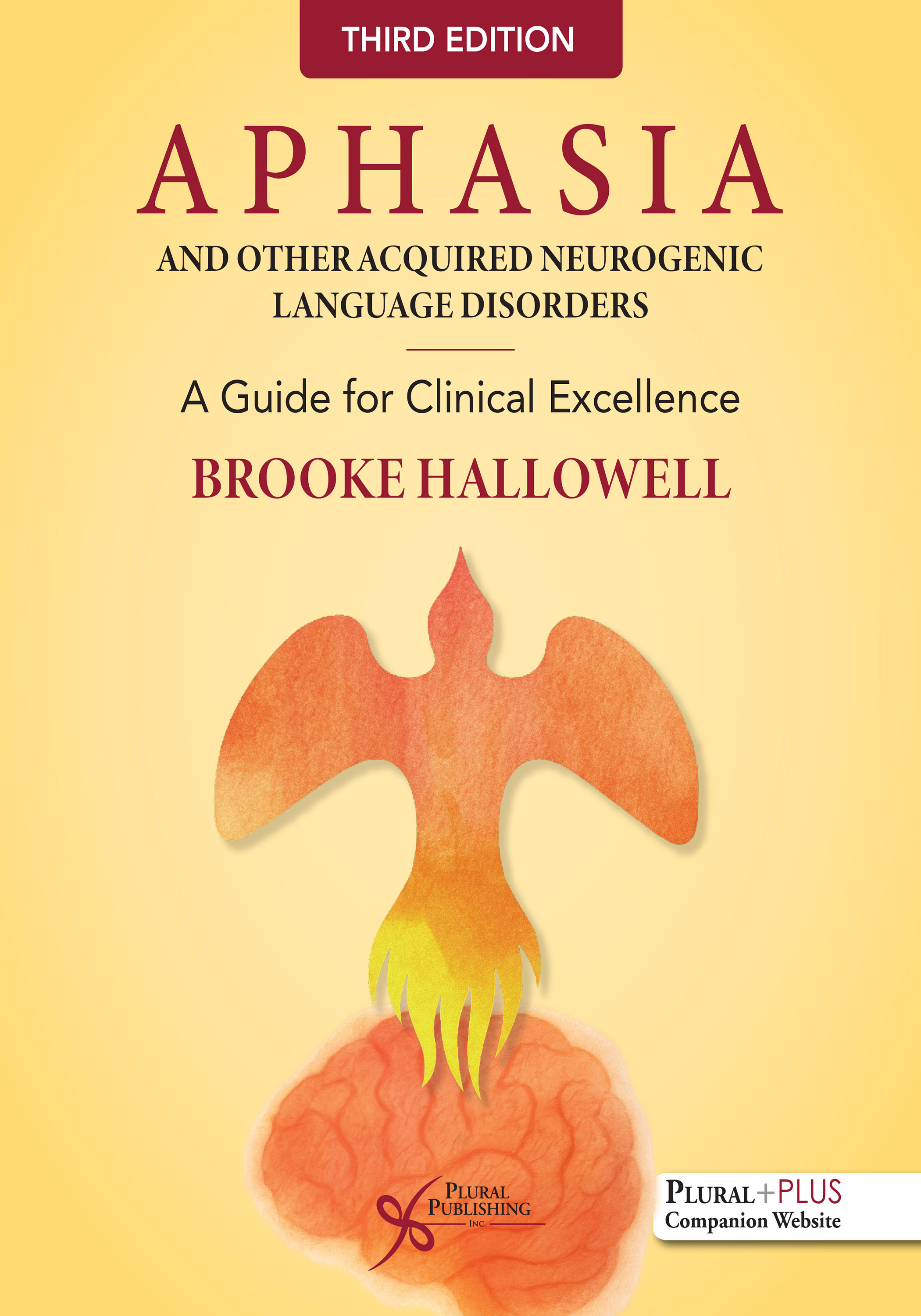
Aphasia and Other Acquired Neurogenic Language Disorders: A Guide for Clinical Excellence
Third Edition
Brooke Hallowell
Details: 600 pages, Full Color, Softcover, 8.5" x 11"
ISBN13: 978-1-63550-820-8
© 2027 | Available
For Instructors
Purchase
Aphasia and Other Acquired Neurogenic Language Disorders: A Guide for Clinical Excellence, Third Edition continues to set the standard for graduate-level education and guidance for clinicians in neurogenic communication disorders, bridging rigorous science with deeply human, person-centered care. Grounded in evidence and shaped by decades of clinical, research, and teaching expertise, this comprehensive text equips future and practicing speech-language pathologists to become thoughtful, skilled, and transformative clinicians.
Designed with students and clinicians in mind, this edition offers a cohesive voice that integrates diverse theoretical perspectives from well over 2,000 references while maintaining clarity, consistency, and clinical relevance across topics. Its flexible organization supports a range of course structures from aphasia-focused classes to broader neurogenic communication disorders sequences, making it an adaptable cornerstone text across curricula.
With its unwavering commitment to life participation, cultural responsiveness, and global perspectives, this text prepares readers to support individuals with neurogenic communication disorders in reclaiming identity, agency, and meaningful engagement in life.
New to the Third Edition
- Fresh updates highlighting evidence-based person-first approaches to clinical practice and research
- Dynamic learning methods woven into the composition of each chapter, with colorful images integrated throughout
- Heightened foci on engaged, transformational learning with the goal of clinical excellence
- Amplified content on mental health, counseling, group treatment, telepractice, new technologies, and artificial intelligence
- Updated and strengthened emphasis on culturally responsive practice, inclusive terminology, and actionable approaches to diversity, equity, and inclusion
- Vital updates on dementia, primary progressive aphasia, aging, and apragmatism
- Integrated voices of people with neurogenic communication disorders to bring life to academic content
Key Features
- Extensive assessment resources and a process analysis approach for analyzing communicative performance and interpreting assessment results
- How-to content on more than 60 intervention approaches
- Diagrams, charts, illustrations, summary tables, a substantial glossary, rich up-to-date references, and a detailed index
- Content design applying adult learning research to maximize deep learning
PluralPlus Online Ancillaries
For instructors: Instructor’s Guide, PowerPoint Slides, Test Bank, Class Activities
For students: Quizzes, Videos, Activities/Exercises, Chapter Queries, Terminology List, Term Pronunciation
Contents
What Is Special About This Book
About the Book Cover
Acknowledgments
About the Author
Section I. Welcome and Introduction
Chapter 1. Welcome to the Fantastic World of Research and Clinical Practice in Acquired Neurogenic Communication Disorders
What Are Acquired Cognitive-Linguistic Disorders?
Which Neurogenic Communication Disorders Are Not Acquired Language Disorders?
What Is Clinical Aphasiology?
What Is So Fantastic About the World of Neurogenic Communication Disorders?
We Work With Wonderful People and Become Part of Their Rich Life Stories
We Are Catalysts for Positive Change
We Enjoy Empowerment of Others Through Advocacy and Leadership
We Enjoy a Great Deal of Humor and Fascination
We Enjoy Fantastic Local and Worldwide Networks
Our Work Is Multicultural and Multilingual
We Are Lifelong Learners
We Tap Into Our Most Scientific and Our Most Creative Selves at the Same Time
We Have Rich Career Opportunities
What Disciplines Are Relevant to Aphasia and Related Disorders?
What Is Known About the Incidence and Prevalence of Acquired Neurogenic Language Disorders?
Where Do Aphasiologists Work?
What Is the Career Outlook for Professionals Specializing in This Area?
Learning and Reflection Activities
Chapter 2. Becoming the Ultimate Excellent Clinician
What Makes a Clinician Truly Excellent?
What Can One Do to Become an Excellent Clinical Aphasiologist?
How Do the People We Serve Characterize What They Most Want?
What Are Some Traits of Clinicians Who Are Perceived as Unhelpful?
What Content Is Important to Master?
What Credentials Are Required for a Career as an Aphasiologist?
What Credentials May Aphasiologists Earn Beyond Their Basic Academic and Clinical Credentials?
Is It Best to Specialize or Generalize?
What Strategies Help Boost Career Development in Acquired Cognitive-Linguistic Disorders?
What Organizations Support Professional Information Sharing and Networking Among Clinical Aphasiologists?
Learning and Reflection Activities
Chapter 3. Writing and Talking About the People With Whom We Work
What Is Important to Consider in Writing and Talking About People With Neurogenic Cognitive-Linguistic Disorders?
Person-First Language
Alternatives to the Word Patient
People With Disabilities
Research Participants
Older People
Healthy Adults
Neurotypical People
What Are Important Nuances in Terms We Use to Refer to People Who Care for People With Neurogenic Cognitive-Linguistic Disorders?
What Is the Difference Between the Terms Therapy and Treatment?
What Are Pros and Cons of Terms Used to Refer to SLPs?
What Are the Preferred Terms When Referring to the Experts Who Work With People Who Have Neurogenic Communication Challenges?
What Is Important to Keep in Mind Regarding Inclusive and Welcoming Language?
What Other Terms Might Unintentionally Convey Negative Connotations?
Why Are There Inconsistencies in the Prefixes Used in Terms for Characterizing Neurogenic Symptoms, and What Is the Rationale for Varied Prefix Choices?
Learning and Reflection Activities
Section II. Foundations for Considering Acquired Neurogenic Language Disorders
Chapter 4. Defining and Conceptualizing Aphasia
What Is a Good Way to Define Aphasia?
Aphasia Is Acquired
Aphasia Has a Neurological Cause
Aphasia Affects Reception and Production of Language Across Modalities
Aphasia Is Not a Speech, Intellectual, Sensory, or Psychiatric Disorder
How Have Established Aphasiologists Defined Aphasia?
What Are the Primary Frameworks for Conceptualizing Aphasia?
Unidimensional Frameworks
Multidimensional Frameworks
Medical Frameworks
Cognitive Neuropsychological, Psycholinguistic, and Neurolinguistic Frameworks
Biopsychosocial Frameworks
Social Frameworks
Social Determinants of Health Frameworks
Other Historically Relevant Frameworks
How Does One Choose a Preferred Framework for Conceptualizing Aphasia?
How Are the Frameworks for Conceptualizing Aphasia Relevant to Other Neurogenic Language Disorders?
Learning and Reflection Activities
Chapter 5. The WHO ICF, Human Rights Perspectives, and Life Participation Approaches
What Is the WHO ICF?
How Is the WHO ICF Relevant to Ethics and Human Rights?
How Is the WHO ICF Specifically Relevant to Intervention and Research in Rehabilitation?
How Is the WHO ICF Specifically Relevant to People With Neurogenic Language Disorders?
Learning and Reflection Activities
Chapter 6. Etiologies of Acquired Neurogenic Language Disorders
What Is a Stroke?
What Are Stroke Risk Factors, and What Causes Stroke?
What Are the Physiological Effects of Stroke?
How Crucial Is Timing for Medical Treatment After a Stroke?
How Is the Sudden Onset of Stroke Relevant to Supporting Patients and Families?
What Is a Transient Ischemic Attack?
What Is Hypoperfusion?
What Can Be Done to Prevent Stroke?
Attending to Stroke Triggers
What Is TBI?
What Are Blast Injuries?
What Are Concussion and Mild TBI?
What Is Chronic Traumatic Encephalopathy?
What Can Be Done to Prevent TBI?
What Are Bacteria and Viruses?
What Other Types of Infections Affect Cortical Function?
What Is Neoplasm?
What Is Toxemia?
What Are Diabetes Mellitus and Diabetic Encephalopathy?
What Is Metabolic Syndrome?
What Other Metabolic Disorders Cause Encephalopathy?
What Is Neurodegenerative Disease?
What Is Dementia and Major Neurocognitive Disorder?
What Is Mild Cognitive Impairment?
What Is Primary Progressive Aphasia?
What Can Be Done to Slow or Reduce the Risk of Cognitive Decline?
What Are Some Special Challenges in Identifying Etiologies of Cognitive-Linguistic Disorders?
Learning and Reflection Activities
Chapter 7. Neurophysiology and Neuropathology of Acquired Neurogenic Language Disorders
What Should SLPs Know About Neuroanatomy and Neurophysiology Associated With Neurogenic Cognitive-Linguistic Disorders?
What Are Key Neurophysiological Principles Pertinent to Acquired Cognitive-Linguistic Disorders?
Specialization of Structure and Function
Interconnectivity Throughout the Brain
The Brain's Plasticity
What Is the Most Clinically Pertinent Knowledge an Aphasiologist Should Have About the Blood Supply to the Brain?
What Factors Affect a Person's Prognosis for Recovery From a Stroke or Brain Injury?
Why Is It Important for Clinical Aphasiologists to Know About the Visual System?
What Aspects of the Visual System Are Most Relevant to People With Neurogenic Cognitive-Linguistic Disorders?
Anatomy and Physiology Associated With Visual Deficits
How Are Visual Field Deficits Characterized?
What Are Ocular Motor Deficits?
What Are Visual Attention Deficits?
What Are Higher Level Visual Deficits?
What Aspects of the Neurophysiology of Hearing Are Most Relevant to People With Neurogenic Language Disorders?
Learning and Reflection Activities
Supplemental Review of Neuroanatomy Related to Aphasiology
Supplemental Review of Blood Supply to the Brain
Supplemental Review of the Visual System
Supplemental Review of the Auditory System
Chapter 8. Neuroimaging and Other Neurodiagnostic Instrumentation
What Are the Most Relevant Neuroimaging Techniques for Aphasiologists to Know About?
Computed Axial Tomography
Magnetic Resonance Imaging
Positron Emission Computed Tomography
Single Photon Emission Computed Tomography
Functional Near-Infrared Spectroscopy
Cerebral Angiography
What Other Neurodiagnostic Methods Are Important for Aphasiologists to Know About?
Electroencephalography
Electrocorticography
Additional Methods
Learning and Reflection Activities
Chapter 9. Aging, Which Is Not a Disorder, and Its Relevance to Aphasiology
What Is Aging?
What Are Key Theories About Aging That Are Especially Relevant to Cognition and Communication?
What Is Aging Well?
How Are Demographic Shifts in Aging Populations Relevant to SLPs?
What Are Normal Changes in the Brain as People Age?
What Are Positive Aspects of the Aging Brain?
Memory
Word Finding
Syntactic Processing
Reading and Writing
Discourse
Pragmatics
What Are General Guidelines for Differentiating Normal From Impaired Language in Older Adults?
What Theories Have Been Proposed to Account for Cognitive-Linguistic Changes With Aging?
Resource Capacity Theories
Working Memory Theories
Context-Processing Deficiency Theories
Signal Degradation Theories
Transmission Deficit Theories
Speed-of-Processing Theories
Inhibition Theories
What Can Be Done to Ensure the Best Preservation of Language Abilities as People Age?
What Is Elderspeak, and How Can We Raise Awareness About It?
What Sensitivities Related to Ageism Are Important for SLPs to Demonstrate?
Learning and Reflection Activities
Section III. Features, Symptoms, and Syndromes in the Major Categories of Cognitive-Linguistic Disorders
Chapter 10. Syndromes and Hallmark Characteristics of Aphasia
How Are the Types of Aphasia Classified?
What Are the Classic Syndromes of Aphasia, and What Are the Hallmark Characteristics of Each?
Expressive–Receptive, Nonfluent–Fluent, and Anterior–Posterior Dichotomies
Classic Aphasia Classification
Wernicke's Aphasia
Broca's Aphasia
Global Aphasia
Conduction Aphasia
Transcortical Sensory Aphasia
Transcortical Motor Aphasia
Mixed Transcortical Aphasia
What Is Primary Progressive Aphasia?
What Other Syndromes of Aphasia Are There, and What Are Their Characteristics?
Crossed Aphasia
Subcortical Aphasia
Anomic Aphasia
Latent Aphasia
How Might Dyslexia and Dysgraphia Be Conceptualized as Symptoms Versus Syndromes?
What Are Limitations of Classification Systems Based on Relationships Between Function and Neuroanatomical Structures?
Learning and Reflection Activities
Chapter 11. Cognitive-Communicative Challenges Associated With Traumatic Brain Injury
Why Is It Hard to Generalize About TBI Survivors?
What Communication Symptoms Are Likely to Be Experienced by TBI Survivors
What Are Special Challenges for War- and Terrorism-Related TBI Survivors?
What Are Special Considerations for Clinicians Working With TBI Survivors?
Scope of Practice
Interdisciplinary Collaboration
Assessment Challenges
What Are Special Challenges Faced by TBI Survivors in Health Care Contexts?
What Special Economic Considerations Affect Clinical Work With TBI Survivors?
Learning and Reflection Activities
Chapter 12. Right Hemisphere Syndrome and Apragmatism
What Is Right Hemisphere Syndrome and What Is Apragmatism?
How Can RHS Affect Communication and Life Participation?
Conversation, Discourse, Pragmatics
Combined Receptive and Expressive Challenges
Receptive Challenges
Expressive Challenges
Attention Deficits
Memory Challenges
Executive Function Challenges
Visual-Perceptual Impairments
Auditory-Perceptual Impairments
Reading and Writing Impairments
What Are Special Challenges That SLPs Face in Serving People With RHS?
Underdiagnosis and Lack of Awareness of RHS
Symptom Classification
Identifying Neurological Structure–Function Relationships
Characterizing What Is Normal
What Are Special Challenges Faced by People With RHS in Health Care Contexts?
Learning and Reflection Activities
Chapter 13. Cognitive-Communicative Disorders in Dementia and Primary Progressive Aphasia
What Neurodegenerative Conditions Most Commonly Affect Cognitive-Linguistic Abilities?
What Communication Challenges Are Typically Associated With MCI and Dementia?
What Symptoms Are Associated With Common Forms of Dementia?
Alzheimer's Disease
LATE Dementia
Vascular Dementia
Dementia With Lewy Bodies
Parkinson's-Associated Dementia
Frontotemporal Dementia
Huntington’s Disease
Korsakoff’s Syndrome
Creutzfeldt-Jakob Disease
AIDS Dementia Complex
What Are Symptoms of the Primary Forms of PPA?
Is There Such a Thing as “Reversible” Dementia?
What Are Implications of an Incorrect Diagnosis of Dementia?
What Is the Role of the SLP in Working With People Who Have PPA and Dementia?
Learning and Reflection Activities
Section IV. Delivering Excellent Services
Chapter 14. Contexts for Providing Excellent Services
What Do SLPs Who Specialize in Neurogenic Communication Disorders Do?
Clinical Intervention (Screening, Assessment, Treatment, Counseling, Educating)
Interprofessional Collaboration and Interdisciplinary Learning
Advocacy
Marketing, Negotiating Contracts, Billing, Recordkeeping, Documentation, Scheduling and Coordinating Care, Quality Assurance, and Fundraising
Leadership and Management
Research
Teaching and Mentoring
In What Types of Settings Do We Provide Clinical Services?
Hospitals
Rehabilitation Centers
Health Maintenance Organizations
Skilled Nursing and Long-Term Care Facilities
Continuing Care Retirement Communities
Home Health Agencies
Private Practice and Not-for-Profit Clinics
University-Based Clinics
Adult Day Care Centers
Aphasia Centers
Hospice
In What Ways Can Services Be Provided at a Distance?
With What Types of Teams Do Clinical Aphasiologists Engage?
How Do SLPs Get Paid?
Where Does the Money Come From to Pay for SLP Services?
Government-Sponsored Programs
Health Insurance
Private Pay
Mixed Funding Options
Philanthropic Donations
How Do Service-Providing Agencies Get Paid?
What Makes Services Provided by SLPs Reimbursable?
Effective Documentation Meeting All Requirements for Reimbursement
A Physician’s Order
Preauthorization for Services by the Third-Party Payer
Evidence That the Services Are Actually Covered by the Plan
Evidence of the Need for Skilled Services
Confirmation That the Methods Used Are Evidence Based
Documentation of the Life-Affecting Nature of Services
Evidence of Treatment Progress
Good Relationships With Decision Makers at Third-Party Payer Agencies
What Are the Primary Reasons for Which Reimbursements for SLP Services Are Denied?
What Do We Do If We Are Denied Reimbursement for Our Services?
How Do Health Care Finance and Cost-Control Systems Affect Clinical Services?
What Are the Impacts of Health Care Cost Cutting and Cost Control on Services for People With Neurogenic Communication Challenges?
Learning and Reflection Activities
Chapter 15. Engaging Proactively in Advocacy and Legal and Ethical Concerns
How Can Clinicians and the People We Serve Promote Access to SLP Services and Communication Support?
Enhance Awareness of Communication as a Human Right
Raise Awareness About Neurogenic Communication Challenges and Ways to Support People and Loved Ones Coping With Them
Help Educate Professionals in Health Care Contexts
Encourage Referrals
Advocate for Reduced Medicalization of Communication Disabilities
Promote Community-Based Approaches
Expand Knowledge Translation and Implementation
How Are Human Rights, Morality, Ethics, and Law Relevant to Advocacy for People With Acquired Neurogenic Disorders of Language and Cognition?
What Is the Role of the SLP in Supporting the Rights of Individuals With Aphasia and Related Disorders?
How Do SLPs Engage in Decisions Regarding Competence and Decision-Making?
How Might Financial Conflicts of Interest Affect Our Practices?
What Are Crucial Ethical Concerns Regarding the Use of Artificial Intelligence?
Learning and Reflection Activities
Chapter 16. Clinical Aphasiology Around the World
What Global Trends Are Affecting the Incidence and Prevalence of Neurogenic Communication Disorders?
A Rapidly Expanding Aging Population
Ongoing Demographic Shifts
Increasing and Disproportionate Incidence and Prevalence of Conditions That Cause Neurogenic Communication Disorders
Health Care and Prevention Infrastructure Challenges
Global Health Priorities Undermining Essential Values
What Are Important Priorities for Global Capacity Building to Serve People With Acquired Neurogenic Communication Disorders?
Build Culturally Contextualized Academic and Clinical Programs
Expand Life Participation Approaches
Attend to Cultural Aspects of Health, Aging, and Disability That Might Affect Receptivity to Services
What Are Key Challenges and Opportunities for Enhancing Research in Acquired Neurogenic Communication Disorders at a Global Level?
What Are Important Ethical Considerations for Aphasiologists Engaging in Transnational Work?
Learning and Reflection Activities
Section V. Strategic and Meaningful Assessment
Chapter 17. Best Practices in Assessment
Where and When Does Assessment Happen?
Assessment Happens Throughout Intervention
Treatment Begins the Moment Assessment Starts
What Are the Purposes of Assessment?
What Aspects of Assessment Are Truly Relevant to Actual Clinical Practice?
What Are the Best Practices in Assessment of Acquired Neurogenic Language Disorders?
Do Not Underestimate How Impactful Your Role Is
Focus on the Person
Keep the Person at the Center of the Process
Focus on Life Participation Goals From the Start
Focus on Strengths
Have a Clear Purpose
Ensure the Best Possible Assessment Conditions
Be Strategic in Setting the Location
Be Strategic About Timing
Include Others in the Process
Be Mindful of Multiple Perspectives on Real-Life Impacts of Communication Disability
Speak Directly to the Person
Collaborate
Appreciate That Experts, Not Tests, Are What Determine Diagnoses
Attend to Cultural and Linguistic Differences
Adopt a Process Analysis Approach
Recognize That There Is Always a Chance of Measurement Error
Embrace Assessment as a Research Process
Balance Dynamic Nonstandardized With Standardized Assessment
Integrate Criterion-Referenced Measures
Learning and Reflection Activities
Chapter 18. Psychometrics and Components of Assessment Processes
What Are Important Psychometric Properties to Consider?
What Are Potentially Confounding Factors?
Factors Related to Concomitant Challenges to Health and Well-Being
Test Design Factors
Assessment Context Factors
Interpersonal Factors
What Is Entailed in Screening for Acquired Neurogenic Language Disorders?
What Are the Typical Components of a Comprehensive Assessment Process?
What Information Is Pertinent to Collect During the Case History?
Learning and Reflection Activities
Chapter 19. Problem-Solving Approaches to Differential Diagnosis and Confounding Factors
How Are Potentially Confounding Factors Relevant to Differential Diagnosis?
What Are Important Potentially Confounding Factors in Assessment, and How Do We Address Them?
Age
Intelligence, Literacy, and Education
Visual Problems
Hearing Problems
Motor Challenges
Reading Problems
Dysgraphia and Other Writing Deficits
Problems of Awareness and Arousal
Attention Problems
Lack of Awareness of Deficits
Executive Function Deficits
Pragmatics
Memory Problems
Other Concomitant Cognitive and Linguistic Deficits
Depression and Other Mood Disorders
Anxiety
Emotional Lability
Other Challenges to Health and Well-Being
How Does a Process Analysis Approach to Assessment Help Address Potentially Confounding Factors?
Learning and Reflection Activities
Chapter 20. Tests, Scales, and Screening Instruments
What Are the Most Important Factors in Selecting an Assessment Instrument?
What Is the Reason for Your Assessment?
Who, Specifically, Is Being Assessed?
Does It Provide an Appropriate Index of the Constructs You Wish to Assess?
Does the Tool Allow for Alternative Response Modes in Cases Where Clients Might Have Trouble With Traditional Response Modes?
Might Instructions and Tasks Involved Confound Results?
What Is the Quality of a Given Tool?
Is It Up to Date and Appropriate in Terms of Content?
Does the Tool Complement Your Own Preferences and Preferred Theoretical Frameworks?
How Practical Is the Tool Under Consideration?
Do Others on Your Rehabilitation Team Understand the Results You Report and Your Interpretation of Them?
What Are the Most Important Factors in Evaluating Assessment Instruments?
What Assessment Tools Are Available?
Learning and Reflection Activities
Chapter 21. Discourse and Conversation as Vital Aspects of Assessment
What Is Discourse?
What Are General Categories, Types, or Genres of Discourse?
What Is Conversational or Discourse Analysis?
Why Is Discourse Sampling and Analysis Important?
Discourse, Especially the Social Use of Language, Is Highly Relevant to Every Type of Acquired Neurogenic Disorder
Discourse Analysis Helps Determine Strengths and Weaknesses Not Evident Through Other Forms of Assessment
Discourse Analysis Could Yield Critical Information for Differential Diagnosis
Discourse Analysis Is Vital to Treatment Planning and Assessment of Progress and Outcomes
Discourse Analysis Is an Essential Aspect of Research
What Are Key Strategies for Sampling Discourse?
What Are Key Measures for Indexing Discourse Competence?
What Are Best Practices in Interpreting Discourse Analysis Results?
What Challenges Do Aphasiologists Face in Applying Discourse Analysis in Clinical Practice and Research?
Time
Equipment and Software
Clear Communication and Perceived Relevance
Replicability and Variability in the Evidence Base
Training and Mentorship
How Can Aphasiologists Confront the Challenges in Applying Discourse Analysis in Clinical Practice and Research?
Learning and Reflection Activities
Chapter 22. Documenting Assessment Results and Considering Prognosis
What Are Best Practices in Sharing Assessment Results With Adults Who Have Acquired Cognitive-Linguistic Disorders and the People Who Care About Them?
How Do We Best Make Judgments About Prognosis?
What Are Best Practices for Reporting Assessment Results in Writing?
What Information Is Typically Included in Assessment Reports?
What Abbreviations Are Commonly Used in Clinical Reporting?
Learning and Reflection Activities
Section VI. Theories and Best Practices in Intervention
Chapter 23. Best Practices in Intervention
What Are the Best Practices in the Treatment of Neurogenic Language Disorders?
Embrace Communication as a Human Right
Recognize Assessment as an Ongoing Intervention Process
Be Person Centered
Engage the Person Actively and Meaningfully in Goal Setting
Include Family Members, Care Partners, and Others Whose Roles Are Relevant
Have a Clear Sense of Purpose and Strategy
Engage Communication Partners Outside of the Client's Immediate Circle of Friends and Family
Embrace Cultural and Linguistic Differences
Encourage Self-Coaching
Consider Optimal Timing
Consider Optimal Locations and Conditions
Focus on Functional Communication
Focus on Relevant Material
Focus on Strengths
Be an Interprofessional Team Player
Integrate Evidence-Based Practice With Practice-Based Evidence
Blend Art With Science
Encourage Aphasia-Friendly Oral and Written Communication
Attend to Behavioral Challenges That Impede Successful Interactions
What Does the Excellent Clinician Know About Evidence-Based Practice?
Where Can We Find Pertinent Information to Support Evidence-Based Practice?
How Does the Excellent Clinician Integrate Evidence-Based Practice With Practice-Based Evidence?
How Can Excellent Clinicians Support Knowledge Translation Through Implementation and Systems Science?
Learning and Reflection Activities
Chapter 24. Treatment Theories and Types of Treatment to Enhance Language and Cognition Across All People With Neurogenic Communication Challenges
What Are the Purposes of Treatment Methods?
What Are the Mechanisms of Recovery After Stroke and Brain Injury?
How Can Behavioral Treatment Facilitate Brain Recovery?
How Can Pharmacological Agents Facilitate Brain Changes?
How Can Brain Stimulation Facilitate Brain Changes?
What Other Types of Intervention Can Facilitate Brain Changes?
Can We Differentiate Spontaneous Recovery From Progress Made Through Treatment?
What Are the Optimal Times During Recovery to Initiate Treatment?
What Is the Optimal Focus of Initial Treatment Soon After a Stroke or Brain Injury?
Focus on Communication Needs
Counsel and Share Information
Promote Rest
Consider the Balance of Compensatory With Restitutive Approaches
What Is the Optimal Intensity and Duration of Treatment?
What Is the Best Level of Complexity for Treatment Foci?
What Other Treatment Parameters Are Important to Consider?
How Might Intervention in Neurodegenerative Conditions Slow Cognitive-Linguistic Decline?
What Is the Best Time to Initiate Treatment With People Who Have Neurodegenerative Conditions?
Learning and Reflection Activities
Section VII. General Approaches to Treatment
Chapter 25. General Approaches for Enhancing Cognitive-Linguistic Abilities in Traumatic Brain Injury, Stroke Survivors, and People With Primary Progressive Aphasia and Dementia
What Is Treatment Fidelity, and How Is It Relevant to Neurogenic Communication Disorders?
What General Social and Life Participation Models Are Applicable to Treatment?
Life Participation Approaches
Supported Communication
What Are Important Aspects to Consider for Group Treatment?
What General Treatment Methods Fit Within Social and Life Participation Models?
Total Communication Approaches
Partner and Caregiver Training
Reciprocal Scaffolding
Workplace Immersion Programs
Mentoring Programs
Toastmaster Programs
Humor as Therapy
Online Games
Applied Improvisation for Communication
Group Singing and Choirs
Animal Assisted Intervention
Friendship and Peer Support Programs
Other Socially Focused Programs
What General Cognitive Neuropsychological Approaches Are Applicable to Treatment?
What Is Cognitive Rehabilitation?
What Is the Stimulation-Facilitation Approach?
How Can Alternative and Augmentative Communication Be Used to Support Communication and Intervention?
What Are Important Considerations for the Use of Artificial Intelligence to Support Communication Intervention?
How Can AI, Apps, and Software Be Used to Support Communication and Aid in Treatment?
What Are Intensive and Residential Programs, and How Can They Help People With Aphasia and Related Disorders?
Learning and Reflection Activities
Chapter 26. Facilitating Communication in People With Primary Progressive Aphasia and Dementia
What Are Special Service Delivery Challenges for Serving People With PPA and Dementia?
How Is Working With People Who Have PPA and Dementia Recognized as a Component of the SLP’s Scope of Practice?
What SLP Services for People With Dementia Are Reimbursable?
What Types of Direct Treatment Can Help People With PPA and Dementia?
What Are Important Approaches for Caregiver Coaching, Training, and Support?
What Are Memory Books and Memory Wallets, and How Are They Implemented?
What Is Spaced Retrieval Training, and How Is It Implemented?
What Is the FOCUSED Program, and How Is It Implemented?
What Is Dementia Collaborative Coaching?
What Are Montessori Approaches to Dementia Management?
What Are Additional Forms of Programming to Support People With PPA and Dementia?
In What Other Ways Can Clinical Aphasiologists Professionally Support the Communication Needs of People With PPA and Dementia and the People Who Care About Them?
How Can Implementation Science Help Us Improve Care for People With Dementia?
Learning and Reflection Activities
Chapter 27. Counseling and Coaching
How Might an SLP Become an Effective Counselor and Coach?
Is the SLP Working With Adults to Be a Counselor, Life Coach, or Both?
What Are Important Considerations Related to Counseling and Scope of Practice?
How Might a Speech-Language Clinician Adopt a Counseling Mindset?
How Does a Clinician Listen and Respond Empathetically and Compassionately?
How Do We Promote a Positive Outlook Without Conveying a Pollyanna Attitude?
How Might Multicultural Differences Affect Counseling and Coaching?
How Might Counseling Moments Be Influenced by the Time Course of Recovery and Intervention?
Counseling Following a Traumatic Change
Counseling at the Start of Intervention
Counseling Related to Assessment Results and Sharing Prognosis
Counseling During Treatment
Counseling at Discharge
How Can Coaching Enhance Self-Advocacy?
What Are Best Practices in Responding to Seemingly Misguided Statements?
What Are Effective Ways to Address Emotional Lability During Clinical Interactions?
What Is the Role of the SLP in Addressing Depression in People With Neurogenic Communication Disorders?
How Can Communication Counseling Enhance End-of-Life Care?
What Are Ways in Which Opportunities for Counseling Can Be Missed?
How Might Some Aspects of Life Improve After Onset of an Acquired Neurogenic Communication Disorder?
How Can People With Acquired Communication Challenges Support One Another?
What Are Some Helpful Information-Sharing Strategies and Resources?
Learning and Reflection Activities
Chapter 28. Complementary and Integrative Approaches
What Are Complementary and Integrative Approaches to Wellness?
How Are Complementary and Integrative Approaches Relevant to Neurogenic Disorders of Language and Cognition?
Why Is It Important for SLPs to Learn About Complementary and Integrative Approaches?
How Are Mind-Body Practices Relevant to People With Cognitive-Linguistic Challenges?
How Might Hypnosis and Visualization Be Relevant to People With Neurogenic Communication Disorders?
What Are the Potential Roles of Religion and Spirituality in Acquired Neurogenic Communication Disorders?
How Might Natural Product Use Be Relevant to People With Cognitive-Linguistic Challenges?
Why Are Complementary and Integrative Approaches Increasing in Popularity?
Frustration With Current Options
Increasing Awareness
Expanded Funding
Increasing Evidence
Aggressive Marketing
What Is the Status of the Evidence Base Supporting Alternative Approaches to Improving Cognitive-Communicative Abilities?
How Can SLPs Support People Considering Complementary and Alternative Approaches to Cognitive-Communicative Wellness?
Stay Within Your Scope of Practice
Engage Only in Methods You Are Trained in and Competent to Carry Out
Emphasize Complementary Over Alternative Approaches to Direct Intervention for Communication and Cognition
Keep an Open, Nonjudgmental Attitude and Appreciate Multicultural Differences
Encourage Caution When Counseling People Considering Alternative and Complementary Approaches
Learning and Reflection Activities
Section VIII. Specific Treatment Approaches
Chapter 29. Specific Approaches for Promoting Compensatory Communication Strategies
What Is Promoting Aphasics’ Communicative Effectiveness (PACE)?
On What Principles Is PACE Treatment Based?
How Is PACE Treatment Implemented?
What Is the Status of PACE in Terms of Evidence-Based Practice?
What Is the Communicative Drawing Program?
On What Principles Is CDP Based?
How Is CDP Implemented?
What Is the Status of the CDP in Terms of Evidence-Based Practice?
What Is Back to the Drawing Board?
On What Principles Is BDB Treatment Based?
How Is BDB Implemented?
What Is the Status of BDB in Terms of Evidence-Based Practice?
What Is Visual Action Therapy?
On What Principles Is VAT Treatment Based?
How Is VAT Implemented?
What Is the Status of VAT in Terms of Evidence-Based Practice?
Learning and Reflection Activities
Chapter 30. Specific Approaches for Enhancing Expressive Language
What Is Constraint-Induced Language Therapy?
On What Principles Is CILT Based?
How Is CILT Implemented?
What Is the Status of CILT in Terms of Evidence-Based Practice?
What Is Script Training?
On What Principles Is Script Training Based?
How Is Script Training Implemented?
What Is the Status of Script Training in Terms of Evidence-Based Practice?
What Is Melodic Intonation Therapy?
On What Principles Is MIT Based?
How Is MIT Implemented?
What Is the Status of MIT in Terms of Evidence-Based Practice?
What Is Voluntary Control of Involuntary Utterances?
On What Principles Is VCIU Treatment Based?
How Is VCIU Implemented?
What Is the Status of VCIU in Terms of Evidence-Based Practice?
What Is Response Elaboration Training?
On What Principles Is RET Based?
How Is RET Implemented?
What Is the Status of RET in Terms of Evidence-Based Practice?
What Is Treatment for Aphasic Perseveration?
On What Principles Is TAP Based?
How Is TAP Implemented?
What Is the Status of TAP in Terms of Evidence-Based Practice?
Learning and Reflection Activities
Chapter 31. Specific Approaches for Improving Word Finding and Lexical Processing
What Are Cuing Hierarchies for the Treatment of Anomia?
On What Principles Are Cuing Hierarchies for the Treatment of Anomia Based?
How Is Cuing Hierarchy Treatment Implemented?
What Is the Status of Cuing Hierarchies for the Treatment of Anomia in Terms of Evidence-Based Practice?
What Is Semantic Feature Analysis?
On What Principles Is SFA Treatment Based?
How Is SFA Treatment Implemented?
What Is the Status of SFA in Terms of Evidence-Based Practice?
What Is Phonological Components Analysis?
On What Principles Is PCA Treatment Based?
How Is PCA Treatment Implemented?
What Is the Status of PCA in Terms of Evidence-Based Practice?
What Is Abstract Semantic Associative Network Training?
On What Principles Is AbSANT Based?
How Is AbSANT Implemented?
What Is the Status of AbSANT in Terms of Evidence-Based Practice?
What Is Phonomotor Treatment?
On What Principles Is PMT Based?
How Is PMT Implemented?
What Is the Status of PMT in Terms of Evidence-Based Practice?
What Is Verb Network Strengthening Treatment?
On What Principles Is VNeST Based?
How Is VNeST Implemented?
What Is the Status of VNeST in Terms of Evidence-Based Practice?
What Is Verb as Core?
On What Principles Is VAC Treatment Based?
How Is VAC Treatment Implemented?
What Is the Status of VAC in Terms of Evidence-Based Practice?
Learning and Reflection Activities
Chapter 32. Specific Approaches for Improving Syntax
What Is Treatment of Underlying Forms?
On What Principles Is TUF Based?
How Is TUF Implemented?
What Is the Status of TUF in Terms of Evidence-Based Practice?
What Is Mapping Therapy?
On What Principles Is Mapping Therapy Based?
How Is Mapping Therapy Implemented?
What Is the Status of Mapping Therapy in Terms of Evidence-Based Practice?
What Is the Sentence Production Program for Aphasia?
On What Principles Is SPPA Treatment Based?
How Is SPPA Implemented?
What Is the Status of SPPA in Terms of Evidence-Based Practice?
Learning and Reflection Activities
Chapter 33. Specific Approaches for Improving Reading and Writing
What Are Basic Principles That Underlie Most Writing- and Reading-Focused Programs for People With Aphasia?
What Is Copy and Recall Treatment?
On What Principles Is CART Based?
How Is CART Implemented?
What Is the Status of CART in Terms of Evidence-Based Practice?
What Is Anagram and Copy Treatment?
On What Principle Is ACT Based?
How Is ACT Implemented?
What Is the Status of ACT in Terms of Evidence-Based Practice?
What Is the Problem-Solving Approach?
On What Principles Is the Problem-Solving Approach Based?
How Is the Problem-Solving Approach Implemented?
What Is the Status of the Problem-Solving Approach in Terms of Evidence-Based Practice?
What Is Multiple Oral Rereading?
On What Principles Is MOR Treatment Based?
How Is MOR Implemented?
What Is the Status of MOR in Terms of Evidence-Based Practice?
What Is Oral Reading for Language in Aphasia?
On What Principles Is ORLA Treatment Based?
How Is ORLA Treatment Implemented?
What Is the Status of ORLA in Terms of Evidence-Based Practice?
Learning and Reflection Activities
Epilogue
Glossary
References
Index

Brooke Hallowell
Brooke Hallowell, PhD, CCC-SLP, brings to this book more than 30 years of clinical, research, teaching, and advocacy experience to support adults with acquired neurogenic communication challenges. She serves on boards and committees of several national and international organizations, including Aphasia Access, Aphasia Recovery Connection, the National Aphasia Association, the Academy of Neurologic Communication Disorders and Sciences, and the American Speech-Language-Hearing Association (ASHA). She is a founding representative of the World Rehabilitation Alliance (WRA), a component of the World Health Organization (WHO) in Geneva, Switzerland. She is an active consultant to the WHO, and she recently chaired ASHA’s committee on ethics in global engagement. She is also an editorial board member and reviewer for many scholarly journals and granting agencies.
Aphasia and Other Acquired Neurogenic Language Disorders: A Guide for Clinical Excellence, Third Edition comes with access to supplementary student and instructor resources on a PluralPlus companion website.
The companion website is located at: https://www.pluralpublishing.com/publication/aoanld3e
STUDENTS:
The student resources include Quizzes, Videos, Activities/Exercises, Chapter Queries, Terminology List, and Term Pronunciation.
To access the student resources, you must register on the companion website and log in using the access code located in the front of your textbook.
INSTRUCTORS:
The instructor resources include Instructor’s Guide, PowerPoint Slides, Test Bank, and Class Activities. You will also have access to all of the student resources listed above.
Cognitive-Communication Disorders of MCI and Dementia: Definition, Assessment, and Clinical Management.
Third Edition
Kathryn Bayles, Kimberly McCullough, Cheryl K. Tomoeda
Details: 265 pages, B&W, Softcover, 7" x 10"
A New Edition is Coming Soon!
ISBN13: 978-1-63550-060-8
© 2020 | Available
A Coursebook on Aphasia and Other Neurogenic Language Disorders.
Fifth Edition
M.N. Hegde
Details: 426 pages, B&W, Spiral, 8.5" x 11"
ISBN13: 978-1-63550-422-4
© 2024 | Available
Acquired Neurogenic Communication Disorders: An Integrated Clinical Approach
First Edition
Jerry K. Hoepner, Margaret Lehman Blake
Details: 362 pages, Full Color, Softcover, 8.5" x 11"
ISBN13: 978-1-63550-425-5
© 2025 | Available
Cognitive Communication Disorders
Fourth Edition
Michael L. Kimbarow, Sarah E. Wallace
Details: 550 pages, B&W, Softcover, 7" x 10"
ISBN13: 978-1-63550-511-5
© 2024 | Available
Acquired Language Disorders: A Case-Based Approach
Fourth Edition
Evelyn R. Klein, James M. Mancinelli, Ryan S. Husak
Details: 355 pages, B&W, Softcover, 8.5"x11"
ISBN13: 978-1-63550-700-3
© 2026 | Available