
Foundations of Speech and Hearing: Anatomy and Physiology
Third Edition
Jeannette D. Hoit, Gary Weismer, Brad H. Story, Rosemary A. Lester-Smith
Details: 386 pages, Full Color, Hardcover, 8.5" x 11"
ISBN13: 978-1-63550-871-0
© 2027 | Available
For Instructors
Purchase
Includes videos!
This accessible and richly illustrated textbook covers the anatomy and physiology of speaking, hearing, and swallowing. Designed primarily for undergraduate students interested in pursuing careers in speech-language pathology, audiology, and speech and hearing sciences, it is written with clinical endpoints in mind and is neither oversimplified nor excessively detailed. The topics covered—including speaking and its subsystems (respiratory, laryngeal, velopharyngeal-nasal, and pharyngeal-oral), hearing and its subsystems (outer, middle, and inner ears), swallowing, and the nervous system—are those that are ultimately relevant to understanding, evaluating, and managing clients with communication and swallowing disorders.
New to the Third Edition
- New coauthor, Rosemary A. Lester-Smith, PhD, CCC-SLP, with substantial knowledge and experience in basic science, clinical application, and classroom teaching
- 100+ new or updated illustrations
- Descriptions of selected instrumentation and measurements commonly used in clinical settings
- Clinical case scenarios with embedded self-test questions to reinforce knowledge and gain insight into real-life applications
- Extensively revised text to enhance clarity and provide support for beginning students
- Updated material based on recent literature
- New and updated online resources (videos, PowerPoint slides, lab activities, study guides, knowledge checks, and test bank)
Key Features
- Numerous beautiful, full-color illustrations
- Complex information presented clearly and concisely, in an easy-to-understand manner
- More than 25 videos that demonstrate key concepts in the text, nearly all of which were created specifically for this book . See the full list of videos here
- Clinical applications are woven throughout the text
- Clinical cases that highlight the relevance of anatomy and physiology to the clinical practices of speech-language pathology and audiology
- “Sidetracks” offer informal and engaging ways to help students connect content to everyday experiences
- A robust offering of online resources for both instructors and students
PluralPlus Online Ancillaries
For instructors: Instructor Overview, PowerPoint Slides, Videos, Lab Activities, Test Banks
For students: Videos, Study Guides, Knowledge Checks
List of Videos
- Anatomy
- Balloon Analogy of the Respiratory System
- Diaphragm Movement
- Ventilation
- Sustained Vowel - Volume and Pressure
- Connected Speech - Volume and Pressure
- Vocal Fold Model
- Adduction, Abduction, Length Change
- Glottal Fricative and Whisper
- Vocal Fold Vibration
- Fundamental Frequency
- Source-Filter
- Velopharyngeal Closure
- VP-N Acoustic Impedance
- Grandfather Passage
- Nasalization
- Hypernasality
- Vowel Articulation
- Consonant Articulation
- Microbeam Abracadabra
- Sliding Articulatory Gestures
- Glossectomee
- Oral Phase Tongue Movement
- Videofluoroscopy Normal
- Videofluoroscopy Abnormal
- Sound to the Brain
Sample Video
Speech production with a source and filter from Chapter 4.
Contents
Preface
Acknowledgments
About the Authors
About the Illustrator
CHAPTER 1. INTRODUCTION TO BASIC CONCEPTS
Introduction
Stages of Spoken Communication
Subsystems
Speech Subsystems
Hearing Subsystems
Directions and Planes
Directions
Anterior/Posterior (Ventral/Dorsal)
Superior/Inferior (Rostral/Caudal)
Medial/Lateral
Proximal/Distal
External/Internal (Superficial/Deep)
Ipsilateral/Contralateral
Planes
Sagittal Plane
Coronal Plane
Horizontal Plane
Tissue Types
Neural Tissue
Muscle Tissue
Connective Tissue
Epithelial Tissue
Movements and Forces
Review
CHAPTER 2. NEURAL STRUCTURES AND FUNCTIONS FOR SPEAKING, HEARING, AND SWALLOWING
Introduction
Organizing Concepts
Central Versus Peripheral Nervous System
Anatomical Planes and Directions
Gray Matter and Nuclei
White Matter and Fiber Tracts
Ganglia
Efferent and Afferent
Lateralization, Specialization, and Somatotopic Organization
Motor and Sensory Integration
Cerebral Hemispheres
Frontal Lobe
Primary Motor Cortex
Broca’s Area
Premotor and Supplementary Motor Area
Prefrontal Cortex
Parietal Lobe
Temporal Lobe
Occipital Lobe
Insula
Limbic System (Limbic Lobe)
Cerebral White Matter
Association Tracts
Striatal Tracts
Commissural Tracts
Descending Projection Tracts
Ascending Projection Tracts
Subcortical Nuclei and Cerebellum
Basal Ganglia
Thalamus
Cerebellum
Brainstem
Surface Features of the Brainstem: Ventral View
Ventral Surface of Midbrain
Ventral Surface of Pons
Ventral Surface of Medulla
Surface Features of the Brainstem: Dorsal View
Dorsal Surface of Midbrain
Dorsal Surface of Pons
Dorsal Surface of Medulla
Cranial Nerves and Associated Brainstem Nuclei
Cranial Nerve V (Trigeminal)
Cranial Nerve VII (Facial)
Cranial Nerve VIII (Vestibulocochlear)
Cranial Nerve IX (Glossopharyngeal)
Cranial Nerve X (Vagus)
Cranial Nerve XI (Spinal Accessory Nerve)
Cranial Nerve XII (Hypoglossal)
Spinal Cord
Spinal Nerves
Cortical Motor Innervation Patterns
Nervous System Cells
Glial Cells
Neurons
Cell Body (Soma)
Dendrites
Axon and Terminal Segment
Synapse
Presynaptic Membrane
Postsynaptic Membrane
Synaptic Cleft
Electrochemical Transmission
Resting Potential
Action Potential
Synaptic Transmission and Neurotransmitters
Neuromuscular Junction
Meninges, Ventricles, and Blood Supply
Meninges
Ventricles and CSF
Blood Supply of Brain
Anterior Circulation
Posterior Circulation
Circle of Willis
Review
References
CHAPTER 3. RESPIRATORY STRUCTURE AND FUNCTION
Introduction
Respiratory Anatomy
Skeletal Framework
Respiratory System Subdivisions
Pulmonary Apparatus
Chest Wall
Pulmonary Apparatus–Chest Wall Unit
Forces of the Respiratory System
Passive Force
Active Force
Muscles of the Rib Cage Wall
Muscle of the Diaphragm
Muscles of the Abdominal Wall
Summary of Passive and Active Forces
Realization of Passive and Active Forces
Movements of the Respiratory System
Movements of the Rib Cage Wall
Movements of the Diaphragm
Movements of the Abdominal Wall
Relative Movements of the Rib Cage Wall and Diaphragm-Abdominal Wall
Forces Underlying Movements
Respiratory Control Variables
Lung Volume
Alveolar Pressure
Chest Wall Shape
Neural Control of Breathing
Control of Tidal Breathing
Control of Special Acts of Breathing
Peripheral Nerves of Breathing
Ventilation and Gas Exchange During Tidal Breathing
Speech Breathing
Extended Steady Utterances
Connected Speech Activities
Variables That Influence Respiratory Structure and Function
Body Position
Body Type
Age
Sex
Ventilation and Drive to Breathe
Cognitive-Linguistic and Social Variables
Clinical Measurements of Respiratory Function
Spirometry
Manometry
Plethysmography
Pulse Oximetry
Clinical Case: Spinal Cord Injury
Review
References
Answers to Clinical Case Questions
CHAPTER 4. LARYNGEAL STRUCTURE AND FUNCTION
Introduction
Laryngeal Anatomy
Skeletal Framework
Thyroid Cartilage
Cricoid Cartilage
Arytenoid and Corniculate Cartilages
Epiglottis
Hyoid Bone
Laryngeal Joints
Cricothyroid Joints
Cricoarytenoid Joints
Internal Topography
Laryngeal Cavity
Vocal Folds
Ventricular Folds
Laryngeal Ventricles
Ligaments and Membranes
Forces of the Larynx
Intrinsic Laryngeal Muscles
Extrinsic Laryngeal Muscles
Supplementary Muscles
Infrahyoid Muscles
Suprahyoid Muscles
Summary of the Laryngeal Muscles
Movements of the Larynx
Movements of the Vocal Folds
Vocal Fold Abduction
Vocal Fold Adduction
Vocal Fold Length Change
Movements of the Ventricular Folds
Movements of the Epiglottis
Movements of the Laryngeal Housing
Laryngeal Control Variables
Laryngeal Opposing Pressure
Laryngeal Airway Resistance
Glottal Size and Configuration
Stiffness of the Vocal Folds
Effective Mass of the Vocal Folds
Neural Control of the Larynx
Laryngeal Function and Speech Production
Transient Noise Production
Sustained Noise Production
Sustained Voice Production
Vocal Fold Vibration
Fundamental Frequency
Sound Pressure Level
Fundamental Frequency-Sound Pressure Level Profiles
Spectrum
Voice Registers
Connected Speech Activities
Fundamental Frequency
Sound Pressure Level
Spectrum
Articulation
Variables That Influence Laryngeal Structure and Function
Age
Sex
Clinical Measurements of Laryngeal Function
Endoscopy
Electroglottography
Aeromechanical Observations
Clinical Case: Vocal Fold Paralysis
Review
References
Answers to Clinical Case Questions
CHAPTER 5. VELOPHARYNGEAL-NASAL STRUCTURE AND FUNCTION
Introduction
Velopharyngeal-Nasal Anatomy
Skeletal Framework
Pharynx
Velum
Nasal Cavities
Outer Nose
Forces of the Velopharyngeal-Nasal Mechanism
Muscles of the Pharynx
Muscles of the Velum
Muscles of the Outer Nose
Movements of the Velopharyngeal-Nasal Mechanism
Movements of the Pharynx
Movements of the Velum
Movements of the Outer Nose
Movements That Change the Size of the Velopharyngeal Port
Velopharyngeal-Nasal Control Variables
Velopharyngeal-Nasal Airway Resistance
Velopharyngeal Sphincter Compression
Velopharyngeal-Nasal Acoustic Impedance
Neural Control of the Velopharyngeal-Nasal Mechanism
Velopharyngeal-Nasal Function and Ventilation
Velopharyngeal Function and Speech Production
Sustained Utterances
Connected Speech Activities
Variables That Influence Velopharyngeal-Nasal Structure and Function
Body Position
Age
Sex
Clinical Measurements of Velopharyngeal-Nasal Function
Nasendoscopy
Aeromechanical Observations
Nasometry
Clinical Case: Cleft Lip and Palate
Review
References
Answers to Clinical Case Questions
CHAPTER 6. PHARYNGEAL-ORAL STRUCTURE AND FUNCTION
Introduction
Pharyngeal-Oral Anatomy
Skeletal Framework
Maxilla
Mandible
Temporomandibular Joints
Internal Topography
Pharyngeal Cavity
Oral Cavity
Buccal Cavity
Mucous Lining
Forces of the Pharyngeal-Oral Mechanism
Muscles of the Pharynx
Muscles of the Mandible
Muscles of the Tongue
Muscles of the Lips
Movements of the Pharyngeal-Oral Mechanism
Movements of the Pharynx
Movements of the Mandible
Movements of the Tongue
Movements of the Lips
Pharyngeal-Oral Control Variables
Pharyngeal-Oral Lumen Size and Configuration
Pharyngeal-Oral Structural Contact Pressure
Pharyngeal-Oral Airway Resistance
Pharyngeal-Oral Acoustic Resonances
Neural Control of the Pharyngeal-Oral Mechanism
Speech Production: Sound Generation and Filtering
Speech Production: Articulatory Descriptions
Vowels
Place of Major Constriction
Degree of Major Constriction
Lip Rounding
Real-Life Vowels
Diphthongs
Consonants
Manner of Production
Place of Production
Voicing
Real-Life Consonants
Speech Production: Articulatory Processes
Coarticulation
Articulatory Phonology or Gesture Theory
Variables That Influence Pharyngeal-Oral Structure and Function
Age
Sex
Clinical Measurements of Pharyngeal-Oral Structure and Function
Structural and Functional Imaging
Articulatory Tracking
Acoustic Observations and Measurement
Clinical Case: Glossectomy
Review
References
Answers to Clinical Case Questions
CHAPTER 7. SWALLOWING STRUCTURE AND FUNCTION
Introduction
Anatomy
Esophagus
Stomach
Salivary Glands
Forces and Movements of Swallowing
Oral Preparatory Phase
Oral Transport Phase
Pharyngeal Phase
Esophageal Phase
Overlap of Phases
Breathing and Swallowing
Neural Control of Swallowing
Role of the Peripheral Nervous System
Role of the Central Nervous System
Variables That Influence Swallowing
Bolus Characteristics
Consistency and Texture
Volume
Taste
Swallowing Mode
Single Versus Sequential Swallows
Cued Versus Uncued Swallows
Body Position
Age
Sex
Clinical Measurements of Swallowing
Videofluoroscopy
Endoscopy
Ultrasonography
Manometry
Clinical Case: Parkinson’s Disease
Review
References
Answers to Clinical Case Questions
CHAPTER 8. AUDITORY SYSTEM STRUCTURE AND FUNCTION
Introduction
Skeletal Framework
Peripheral Anatomy of the Ear
Outer Ear (Conductive Mechanism)
Pinna
External Auditory Meatus
Tympanic Membrane
Middle Ear (Conductive Mechanism)
Ossicles and Associated Structures
Ligaments and Muscles of the Middle Ear
Eustachian Tube
Summary of Middle Ear Structures
Inner Ear (Sensorineural Mechanism)
Semicircular Canals
Vestibule
Cochlea
Cochlear Nerve
Transformation of Sound by the Ear
Transformation of Sound by the Conductive Mechanism
Transformation of Sound by the Sensorineural Mechanism
Central Auditory Pathways
Clinical Measurements of Hearing
Pure-Tone Audiometry
Auditory Brainstem Response
Otoacoustic Emissions
Clinical Case: Unilateral Hearing Loss
Review
References
Answers to Clinical Case Questions
Index

Jeannette D. Hoit
Jeannette D. Hoit, PhD, CCC-SLP (Retired), is Professor Emerita in the Department of Speech, Language, and Hearing Sciences and former director of Postdoctoral Affairs at the University of Arizona. Dr. Hoit received her BA in anthropology from the University of California at Los Angeles, her MA in communication disorders from San Diego State University, and her PhD in speech and hearing sciences from the University of Arizona and pursued postdoctoral study at the Harvard School of Public Health Respiratory Biology Program and Massachusetts Institute of Technology Speech Research Laboratory. Dr. Hoit’s research focused on speech physiology with an emphasis on normal aging and development, neuromotor speech disorders, and respiratory function and dysfunction. Dr. Hoit is past editor of the American Journal of Speech-Language Pathology, a fellow of the American Speech-Language-Hearing Association, and University of Arizona College of Science Galileo Fellow. She has received a Distinguished Alumnus Award from San Diego State University and several teaching and mentoring awards from the University of Arizona.

Gary Weismer
Gary Weismer, PhD, is Oros-Bascom Professor Emeritus in the Department of Communication Sciences & Disorders, University of Wisconsin-Madison. He received his bachelor’s and master’s degrees from the Pennsylvania State University and his doctorate from University of Wisconsin-Madison in 1975. Dr. Weismer’s research publications concern speech production in healthy talkers, as well as speech production and speech intelligibility in persons with motor speech disorders. Dr. Weismer served twice as Associate Editor for the Journal of Speech, Language, and Hearing Research (formerly the Journal of Speech and Hearing Research), as Associate Editor at Folia Phoniatrica et Logopaedica (FPL) from 2004 to 2011, and as Editor-in-Chief at FPL from 2011 to 2016. During his 35 years at University of Wisconsin-Madison, Dr. Weismer won several teaching awards, including for mentoring efforts in the University of Wisconsin-Madison Honors program. Dr. Weismer mentored 16 doctoral students during his career, many of whom are currently scientific leaders and university administrators. He is a past member of the Executive Board of the International Association of Logopedics and Phoniatrics (IALP), an Honored Member of IALP, a Fellow of the Acoustical Society of America, and past chair of his department. He has edited, authored, and coauthored five textbooks.

Brad H. Story
Brad H. Story, PhD, is Professor in the Department of Speech, Language, and Hearing Sciences and Associate Dean of Faculty Affairs in the College of Science at the University of Arizona. Dr. Story received his BS in Applied Physics from the University of Northern Iowa in 1987 and his PhD in Speech and Hearing Sciences from the University of Iowa in 1995. From 1987-1991, he was employed in industry as an engineer where he developed computational models and instrumentation systems for designing and measuring the performance of mufflers. Dr. Story’s research publications concern the mechanics, aerodynamics, and acoustics of speech production, as well as the perception of speech sounds. Dr. Story is a past Associate Editor for the Journal of the Acoustical Society of America, a fellow of the Acoustical Society of America (ASA), and recipient of the ASA’s Rossing Prize in Acoustics Education in 2016. Dr. Story was recognized by the American Speech Language and Hearing Association in 2013 with the Willard R. Zemlin Lecture Award, and by the University of Iowa in 2018 with a Distinguished Alum Award. His research has been supported by the National Institutes of Health and the National Science Foundation.
Foundations of Speech and Hearing: Anatomy and Physiology, Third Edition comes with access to supplementary student and instructor resources on a PluralPlus companion website.
The companion website is located at: https://www.pluralpublishing.com/publication/fshap3e
STUDENTS:
The student resources include Videos, Study Guides, and Knowledge Checks.
To access the student resources, you must register on the companion website and log in using the access code located in the front of your textbook.
INSTRUCTORS:
The instructor resources include Instructor Overview, PowerPoint Slides, Videos, Lab Activities, and Test Banks. You will also have access to all of the student resources listed above.
To access the instructor resources, you must contact Plural Publishing, Inc. to be verified as an instructor and receive your access code.
Email: instructormaterials@pluralpublishing.com
Tel: 866-758-7251 (toll free) or 858-492-1555
*Note for students: If you have purchased this textbook used or have rented it, your access code will not work if it was already redeemed by the original buyer of the book. Plural Publishing does not offer replacement access codes for used or rented textbooks.
The Auditory System: Anatomy, Physiology, and Clinical Correlates
Second Edition
Frank E. Musiek, Jane A. Baran
Details: 487 pages, Full Color, Hardcover, 8.5" x 11"
ISBN13: 978-1-94488-300-3
© 2020 | Available
Preclinical Speech Science: Anatomy, Physiology, Acoustics, and Perception
Third Edition
Thomas J. Hixon, Gary Weismer, Jeannette D. Hoit
Details: 728 pages, Full Color, Hardcover, 8.5" x 11"
ISBN13: 978-1-63550-061-5
© 2020 | Available
Anatomy and Physiology Study Guide for Speech and Hearing
Second Edition
William Culbertson, Stephanie Cotton Christensen, Dennis C. Tanner
Details: 416 pages, B&W, Softcover, 8.5" x 11"
ISBN13: 978-1-59756-496-0
© 2013 | Available
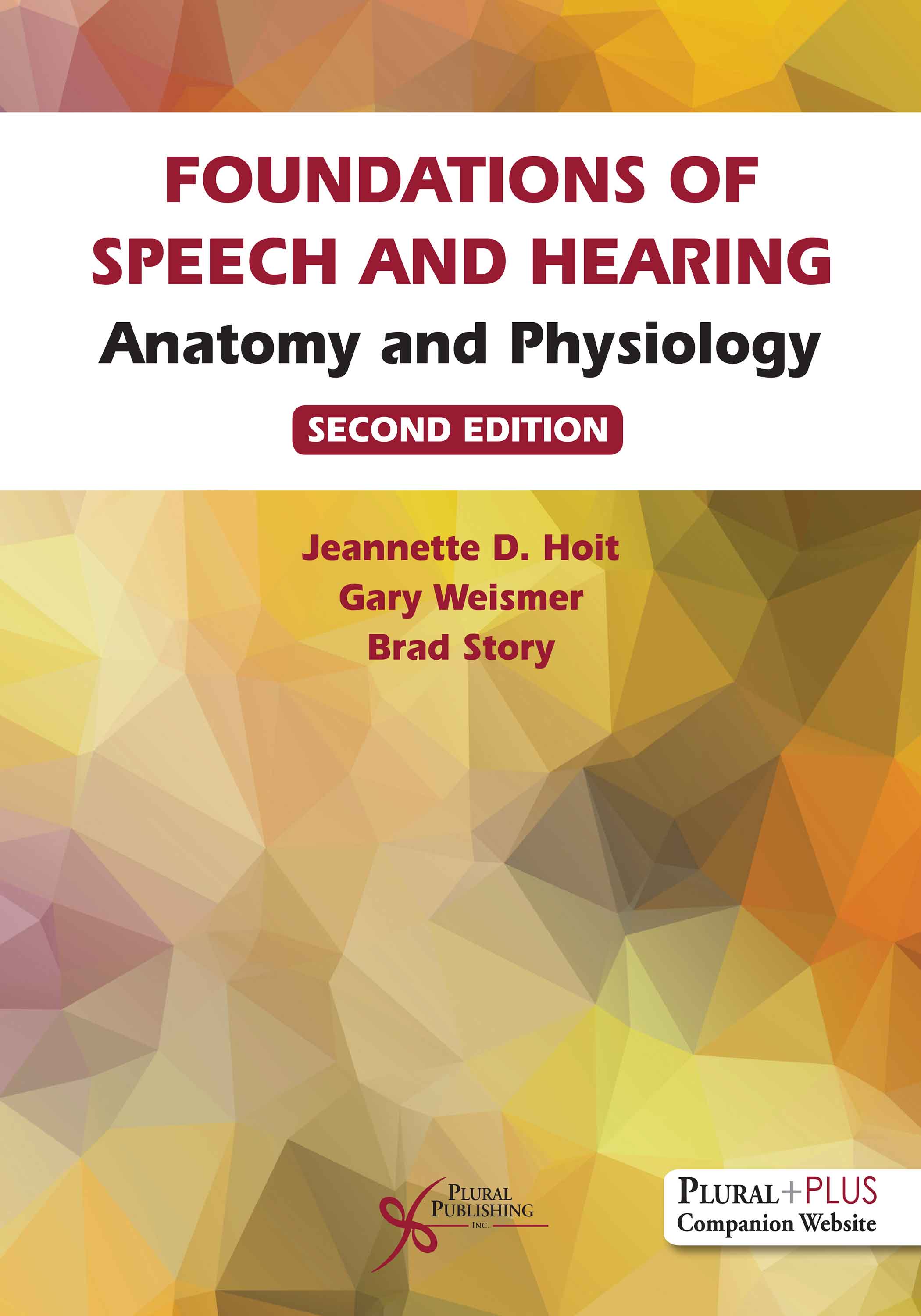
Foundations of Speech and Hearing: Anatomy and Physiology.
Second Edition
Jeannette D. Hoit, Gary Weismer, Brad H. Story
Details: 348 pages, Full Color, Hardcover, 8.5" x 11"
A New Edition is Available!
ISBN13: 978-1-63550-306-7
© 2022 | Available
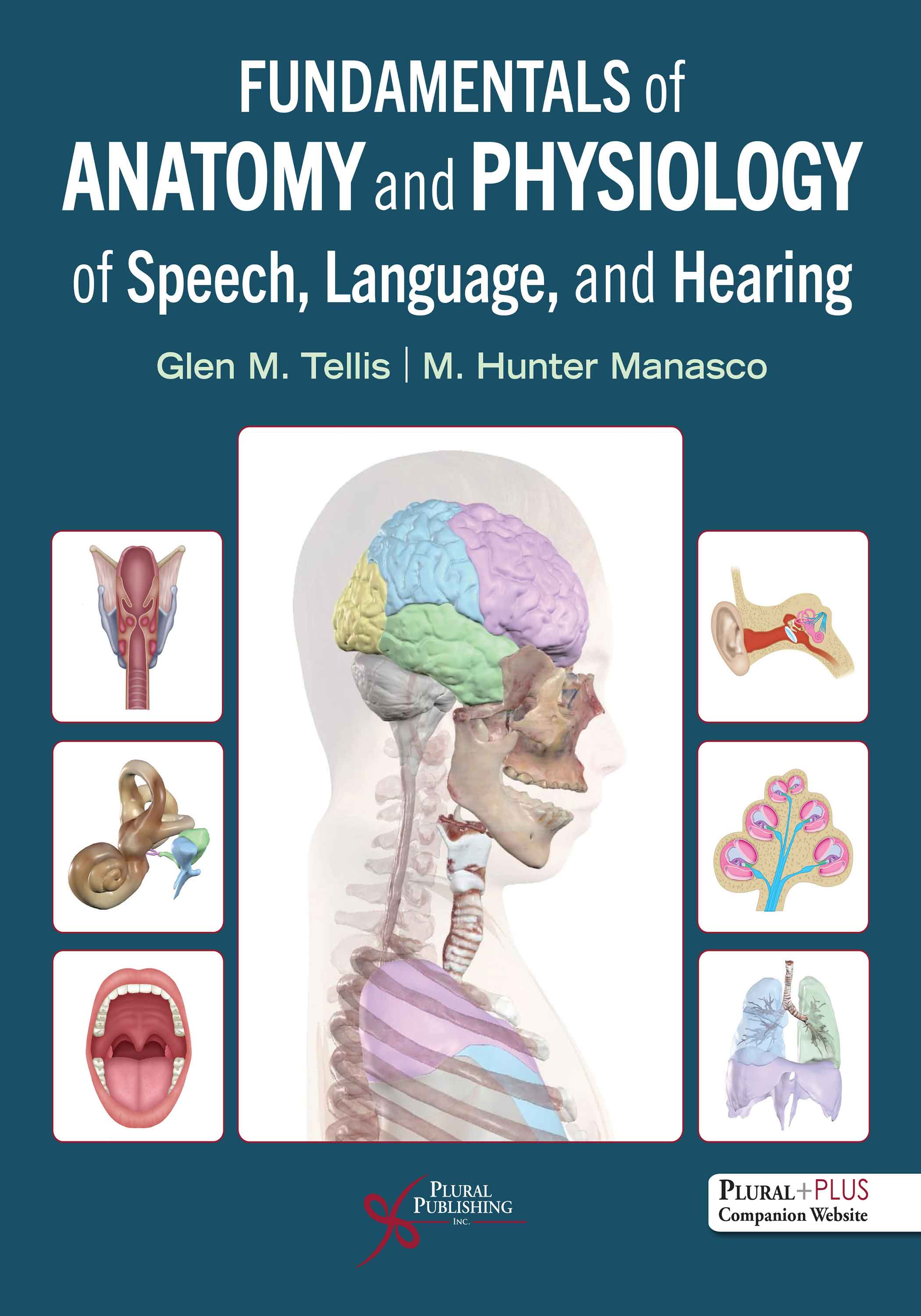
Fundamentals of Anatomy and Physiology of Speech, Language, and Hearing
First Edition
Glen M. Tellis, M. Hunter Manasco
Details: 478 pages, Full Color, Hardcover, 8.5" x 11"
ISBN13: 978-1-63550-720-1
© 2025 | Available