

Multi-Tiered Systems of Support: Implementation Tools for Speech-Language Pathologists in Education
Second Edition
Lesley Sylvan
Details: 363 pages, B&W, Softcover, 7" x 10"
ISBN13: 978-1-63550-780-5
© 2026 | Available
Purchase
For school-based speech-language pathologists (SLPs), Multi-Tiered Systems of Support: Implementation Tools for Speech-Language Pathologists in Education, Second Edition offers practical research-based tools to balance the high demands of their job with supporting general education students. This professional resource provides answers to a range of questions about policy implications, applicability of the framework to an SLP’s role in schools, and how an SLP can implement multi-tiered systems of support (MTSS) in their practice.
Part I breaks down the important concepts of MTSS, while Part II is designed as an SLP MTSS Toolkit with practical suggestions for implementation and data collection, featuring the collective wisdom of practitioners and researchers in the field. Part III is new to this edition and includes an additional toolkit intended to support practitioners in adopting and sustaining MTSS practices in real-world settings. This toolkit moves beyond presenting evidence-based practices to focus on concrete implementation strategies, including communication templates, self-reflection tools, and case studies that illustrate leadership and advocacy related to MTSS in action. Throughout the text, readers will also find real-world snapshots of MTSS in practice based on the experiences of actual SLPs in the field.
New to the Second Edition
- Expanded information on balancing MTSS implementation along with other responsibilities
- More detailed information related to the importance and practical implementation of universal screening
- A new chapter on approaching augmentative and alternative communication (AAC) within an MTSS framework, including case studies of SLPs putting this information into action
- A new “toolkit” for SLPs to reflect on their own practice, communicate with key stakeholders, and deepen their motivation to engage with MTSS
- 28 new “real-world” snapshots illustrating implementation in diverse practice contexts, including virtual schools, charter schools, and schools serving students with identified disabilities
Learn more from the author about MTSS on the Plural Blog.
PluralPlus Online Ancillaries
Forms/Documents
Reviews
“The book is well organized and provides so many practical research-backed strategies for MTSS and speech pathology interventions for students on all grade levels with considerations for multilingual learners and AAC users. It provides resources for professionals at all levels to advocate for, construct and sustain MTSS programs in their schools. It is honest about the challenges that SLPs face for MTSS but gives realistic strategies and implementation suggestions. …I will recommend it to my staff and school administrators. This is useful for new graduates in the field and for professionals who have been asked to implement MTSS in their school or those looking to start programs.”
—Kristin Testani, MS, CCC-SLP
School District Administrator
“Themes of equity, accessibility, prevention, evidence-based practices, data driven decisions, flexibility, and collaboration consistently appeared in each chapter which really speak to the crux of what makes the MTSS framework so powerful. …This book provides a solid understanding of SLP supports within the MTSS framework and a plethora of implementation ideas for SLPs to have at their fingertips.”
—Kim Y. Sanchez, EdD, CCC-SLP
Speech-Language Pathologist, Special School District of St. Louis/Parkway School District
“I love the inclusion of AAC as it relates to MTSS framework! This is an area so prevalent in the field, but often overlooked.”
—Hesper Holland, PhD, CCC-SLP, BCS-AAC
Program Director and Assistant Professor, Texas Tech University Health Sciences Center
“This text would be valuable for seasoned veterans and new clinicians alike. It is also a valuable reference for administrators when trying to make programmatic and hiring decisions. …The book provides strong arguments that the SLP is an integral part of MTSS and that they should not be intimidated by the fear of an increased workload. I have worked in a number of districts where the SLP is not involved in reading or writing instruction, primarily due to fear of an increased workload.”
—Robin L. Alvares, PhD, CCC-SLP
Private Practice
“This book is a well-organized, practitioner-friendly resource that moves logically from foundational concepts to practical tools and reflective application. A major strength is its clear integration of MTSS principles across domains of communication and literacy, with consistent emphasis on the SLP’s role. The inclusion of over 40 “true stories,” along with appendices full of templates, forms, and letters, makes the content highly accessible and actionable for real-world practice. The writing style and Q&A format in early chapters also model how SLPs can communicate effectively with educators.”
—Heather L. Ramsdell, PhD CCC-SLP, CALT, QIT
Associate Professor | Communication Sciences & Disorders | Idaho State University
Owner/Therapist | Once Upon a Time LLC
“The real-life applications are beneficial and provide context for those who may be unfamiliar with certain experiences. The text feels like a conversation and is more literal for practical purposes!”
—Jianwen Crump, EdD, CCC-SLP
Assistant Professor / Clinical Supervisor, Mississippi University for Women
“I particularly like the practical examples/case studies that complement the evidence reported in each chapter. …The coverage of MTSS information is very complete. This will be a strong resource for seasoned SLPs working in school-based settings.”
—Alicia M. Davis, MS, CCC-SLP
Adjunct Clinical Educator, Barkley Memorial Speech/Language and Hearing Clinic
Department of Special Education and Communication Disorders. University of Nebraska-Lincoln
“I like the way some of the information was cycled through multiple times (e.g,. basic guidelines about MTSS, how it differs from RTI, the role that SLPs should play in MTSS, etc.) in each chapter so that it was connected to each and every subtopic discussed (e.g. articulation, language, voice, stuttering, etc.). …The text is very well designed and user-friendly.”
—Mary Coffey, MA, CCC-SLP, MEd, ECSE
Speech-Language Pathologist & Early Childhood Special Educator
Norwich School District, Norwich, Vermont
Contents
Preface
Acknowledgments
Reviewers
Dedication
Part I. MTSS and the SLP: Important Concepts and Decision-Making
Chapter 1. What Do SLPs Need to Know and Explain About their Role in MTSS? A Q&A Overview
Chapter 2. What Decisions Do SLPs Need to Make? Key Decisions and Data Collection
Part II. What Tools Can SLPs Implement, Model, or Teach Within an MTSS Framework for Students in Grades K–12? Toolkit of MTSS Implementation for SLPs
Chapter 3. Introduction to the SLP MTSS Implementation Toolkit
Chapter 4. Tools Related to Speaking and Listening Common Core State Standards
Chapter 5. Tools Related to Reading Common Core State Standards
Chapter 6. Tools Related to Writing Common Core State Standards
Chapter 7. Tools Related to Language Common Core State Standards
Chapter 8. Tools Related to Speech Sound Disorders, Fluency, and Voice
Chapter 9. Tools Related to Alternative and Augmentative Communication (AAC)
Part III. How Can SLPs Translate Knowledge About MTSS Into Meaningful Action? Toolkit for SLPs to Reflect, Communicate, and Become Motivated
Chapter 10. Tools for SLP MTSS to Translate Research to Practice
Appendix A. Data Collection Forms and Templates for Toolkit Activities
Appendix A–1. Form for Tracking Classroom Observations and Discussions
Appendix A–2. General Accuracy Collection Form
Appendix A–3. Pictography Note-Taking Template
Appendix A–4. Cornell Note-Taking Template
Appendix A–5. Alphabet Knowledge and Phonological Awareness Data Collection Form
Appendix A–6. Checklist for Text Preview and Text Lookback Strategy
Appendix A–7. Graphic Organizer to Aid Students in Taking Notes on Word Definitions
Appendix A–8. Semantic Feature Analysis Template
Appendix A–9. Sorting Morphemes Activity Template
Appendix A–10. Morpheme Book Template
Appendix A–11. Universal Visual Supports Staff Log
Appendix B. Letters and Permission Forms
Appendix B–1. Sample Letter to Parents Explaining the SLP’s Role, Including MTSS
Appendix B–2. Parental Permission Form: Permission to Participate in Universal Screening
Appendix B–3. Parental Permission Form: Permission to Follow Up on Speech-Language Concerns
Appendix B–4. Parental Permission Form: Permission to Participate in Support Sessions Run by the Speech-Language Pathologist
Appendix B–5. Letter to School Staff Explaining the SLP’s Role Generally and in MTSS
Appendix C. Self-Reflection, Self-Assessment, and Quick-Start Guide Forms
Appendix C–1. MTSS Pulse Matrix Quiz and Graphs
Appendix C–2. MTSS SWOT Analysis
Appendix C–3. MTSS CHAT Map
Appendix C–4. SLP-MTSS Quick-Start Guide
Afterword
References
Index

Lesley Sylvan
Lesley Sylvan, MS, EdM, EdD, is an associate professor of communication sciences and disorders at Montclair State University. She has an active research agenda focusing on speech-language pathology services in public schools. Dr. Sylvan graduated with a doctoral degree from Harvard University in Human Development and Education and a master’s degree from Boston University in Speech-Language Pathology. Prior to her academic career, Dr. Sylvan was a speech-language pathologist in New York City and San Francisco public schools.
Multi-Tiered Systems of Support: Implementation Tools for Speech-Language Pathologists in Education, Second Edition comes with access to supplementary student and instructor resources on a PluralPlus companion website.
The companion website is located at: https://www.pluralpublishing.com/publication/mtss2e
STUDENTS:
The student resources include Printable Forms/Documents.
To access the student resources, you must register on the companion website and log in using the access code located in the front of your textbook.
*Note for students: If you have purchased this textbook used or have rented it, your access code will not work if it was already redeemed by the original buyer of the book. Plural Publishing does not offer replacement access codes for used or rented textbooks.
The Role of the Speech-Language Pathologist in RtI: Implementing Multiple Tiers of Student Support
First Edition
Wayne A. Foster
Details: 226 pages, B&W, Softcover, 7" x 10"
ISBN13: 978-1-63550-021-9
© 2018 | Available

The Practitioner's Path in Speech-Language Pathology: The Art of School-Based Practice
First Edition
Wendy Papir-Bernstein
Details: 402 pages, B&W, Softcover, 7" x 10"
ISBN13: 978-1-94488-345-4
© 2018 | Available

IEP Goal Writing for Speech-Language Pathologists: Utilizing State Standards
Second Edition
Lydia Kopel, Elissa Kilduff
Details: 243 pages, B&W, Softcover with layflat binding, 8.5" x 11"
ISBN13: 978-1-63550-202-2
© 2021 | Available

Special Education Law and Policy: From Foundation to Application
First Edition
Jacqueline A. Rodriguez, Wendy Murawski
Details: 567 pages, 2-Color, Softcover, 7" x 10"
ISBN13: 978-1-63550-231-2
© 2022 | Available

Treatment Companion: A Speech-Language Pathologist's Intervention Guide for Students With Developmental Delays and Disorders
First Edition
Inna Itskovich, Megan Meyer, Miriam Shaffer
Details: 274 pages, B&W, Softcover, 8.5 " x 11"
ISBN13: 978-1-63550-481-1
© 2023 | Available
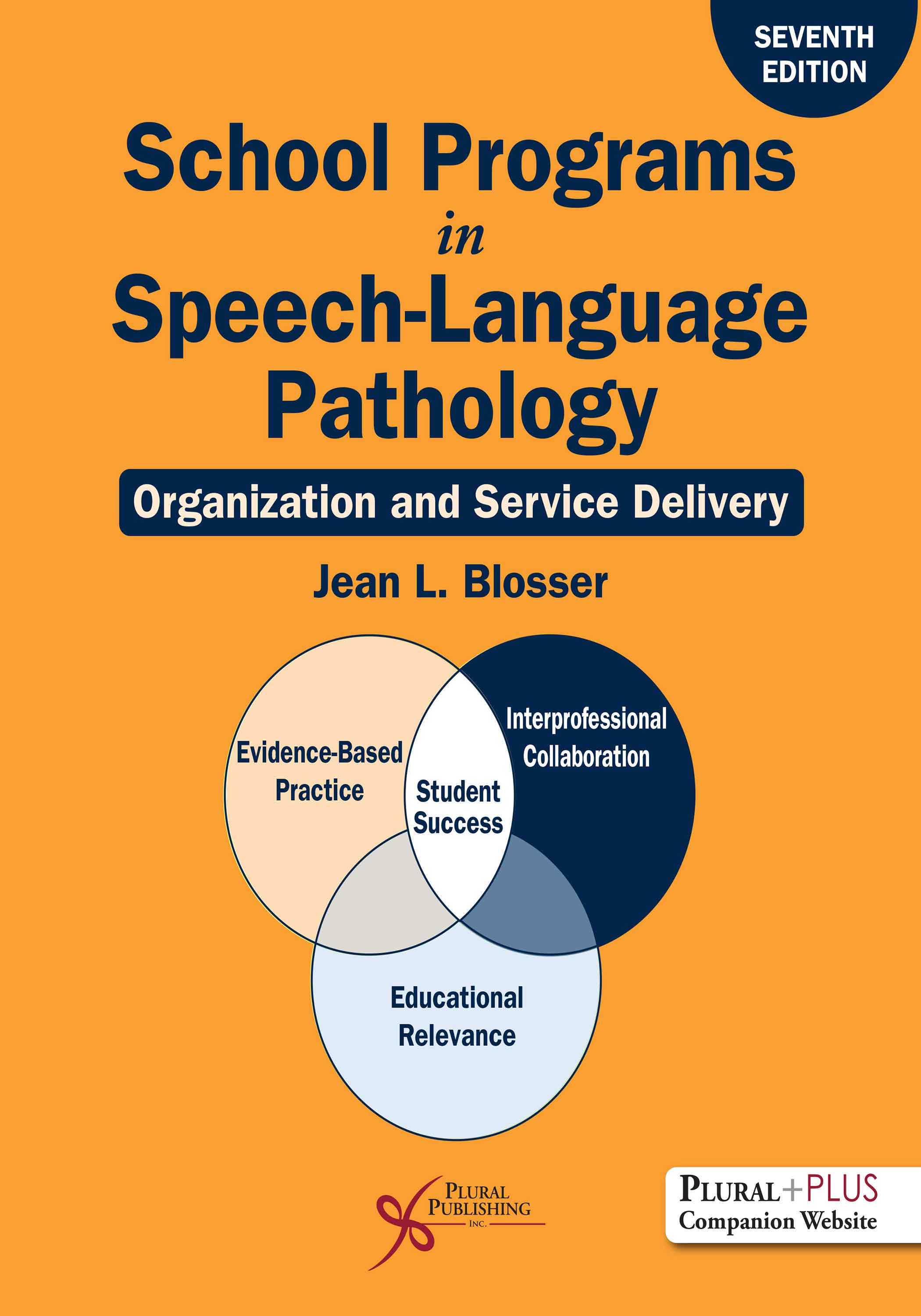
School Programs in Speech-Language Pathology: Organization and Service Delivery
Seventh Edition
Jean Blosser
Details: 457 pages, B&W, Softcover, 8.5 " x 11"
ISBN13: 978-1-63550-611-2
© 2025 | Available

A Guide to School Services in Speech-Language Pathology
Fifth Edition
Trici Schraeder, Courtney Seidel
Details: 313 pages, B&W, Softcover, 8.5" x 11"
ISBN13: 978-1-63550-670-9
© 2026 | Available

Speech-Language Pathology and IDEA: Evaluation and Eligibility for Speech-Language Impairment
First Edition
Angie Neal
Details: 300 pages, B&W, Softcover, 7" x 10"
ISBN13: 978-1-63550-711-9
© 2027 | Coming Soon
Release Date: 10/15/2026