
Speech-Language Pathology and IDEA: Evaluation and Eligibility for Speech-Language Impairment
First Edition
Angie Neal
Details: 419 pages, B&W, Softcover, 7" x 10"
ISBN13: 978-1-63550-711-9
© 2027 | Available
For Instructors
Purchase
Speech-Language Pathology and IDEA: Evaluation and Eligibility for Speech-Language Impairment is a practical, evidence-based guide to help clinical and school-based speech-language pathologists make legally sound, educationally relevant decisions about evaluation and eligibility.
Grounded in federal regulations and case law, this book explains IDEA in clear, unambiguous language to support compliance knowledge, improve caseload and workload management, and ultimately improve student outcomes. Case studies illustrate everyday scenarios, including multilingual learners, screening outcomes, and scope-of-practice questions, helping SLPs confidently translate legal expectations into practice. A glossary of acronyms provides a quick reference to specialized terminology commonly used in special education policy and documentation.
Readers learn not only what the law requires but how to apply it. From Child Find and consent procedures to evaluation timelines, technically sound assessment practices, and defensible eligibility determinations, this text helps SLPs navigate the complex intersection of federal law, clinical judgment, and educational impact. It also provides practical guidance for IEP development, intervention planning, and progress monitoring.
Integrated tools within the text and companion website support immediate application, including parent and teacher handouts, non-standardized assessment tools, eligibility and evaluation rubrics, developmental continua, and links to online resources. These materials help SLPs explain results to teams, document adverse educational impact, support IEP development, and ensure IDEA-aligned decision-making.
By situating practice within the broader legal and educational landscape, this comprehensive resource demonstrates how federal and state regulations, funding structures, and accountability systems shape services, while connecting speech-language development to literacy, educational standards, and long-term academic outcomes for students with speech-language impairments.
Key Features
- Practical tools for writing measurable, standards-aligned IEP goals
- Strategies for collaboration with teachers, families, and multidisciplinary teams
- Support for culturally and linguistically responsive referral, assessment, and intervention
- Realistic case scenarios that present opportunities to apply defensible clinical reasoning
- Glossary of acronyms for quick reference to special education terminology
- Ready-to-use clinical resources, including handouts, non-standardized assessment tools, rubrics, developmental continua, and curated links to validated free online tools
PluralPlus Online Ancillaries
Handouts, Assessment Tools and Rubrics, Forms/Documents, Links to Related Resources
Contents
Foreword
Prologue
Acknowledgments
Reviewers
Chapter 1: SLPs in Schools
Introduction
Preparing SLPs to Work in Schools
Federal Law, State Law, and Guidance
The Need for SLPs in Schools
Increases in Disabilities
Screen Time
Changes to Developmental Milestones
Impacts on Later Literacy
Workload and Caseload
Medical Versus Educational Models of Speech-Language Pathology
Case Scenario and Discussion Questions
Chapter 2: The Individuals With Disabilities Education Act
Introduction
What Is IDEA?
Changes to IDEA
Implementation and Monitoring of IDEA
Case Law
U.S. Department of Education Guidance
The Six Pillars of IDEA
Pillar One: The Individualized Education Program
Pillar Two: Free Appropriate Public Education (FAPE)
Pillar Three: Least Restrictive Environment (LRE)
Pillar Four: Appropriate Evaluations
Pillar Five: Parent and Teacher Participation
Pillar Six: Procedural Safeguards
Case Scenario and Discussion Questions
Chapter 3: IDEA’s Essential Components of the IEP
Introduction
The Individualized Education Program
The IEP Team
IEP Team Member Contributions
IEP Team Member Excusal
Present Levels of Academic Achievement and Functional Performance
Impact Statement
IEP Goals
A Map to Close (or Narrow) the Gap
Making Progress Versus Closing the Gap
Considerations for IEP Goals
Adding IEP Goals That are Not the Result of the Disability
Progress Reports
Accommodations
Modifications
Services: Special Education Versus Related Services
Prior Written Notice
Case Scenario and Discussion Questions
Chapter 4: Requirements Prior to Evaluation
Introduction
Child Find
Hearing and Vision Screening
Hearing Screening
Vision Screening
Guidance Related to Hearing and Vision Screenings
Screening According to IDEA
Preschool Screening
Universal Screening and Screening for Oral Language
Intervention
Exclusionary Factor: Lack of Appropriate Instruction
Exclusionary Factor: Limited English Proficiency
Notice of Procedural Safeguards
Case Scenario and Discussion Questions
Chapter 5: Requirements for Evaluation
Introduction
Evaluation Versus Assessment
Parental Consent for Evaluation
Timeline for Evaluation
Standardized Versus Nonstandardized Assessment Tools
Requirements to Administer a Standardized Assessment
Criticisms of Requirements for Standardized Assessments
Standardized Assessments and Arbitrary Cut Scores
Nonstandardized Assessments
Dynamic Assessment
Informed Clinical Opinion
Notice of Evaluation
A Variety of Assessment Tools and Strategies
Functional or Nonacademic Data
Developmental Data
Academic Data
No Single Measure or Assessment
Technically Sound Instruments
Current Version of Assessment
Sensitivity and Specificity
Cut Scores
Normative Sample
Confidence Interval and Standard Error of Measurement
Bias
Valid and Reliable
Quantitative Scores
Not Discriminatory
Assessments Administered in the Student’s Native Language
Multilingual Learners
Dialect
African American English (AAE)
Final Considerations for Multilingual Learners and Speakers of a Dialect
Valid and Reliable
Trained and Knowledgeable Personnel
Administered in Accordance With Instructions
Educational Need and Intelligence Quotient
Accurately Reflect Aptitude
Sufficiently Comprehensive and in All Areas
Prompt Completion
Determine Educational Needs
Review of Existing Evaluation Data
Observation
The Evaluation Report
Team Determination
Reevaluation
If Additional Information Is Necessary
If Additional Information Is Not Necessary
Independent Educational Evaluation (IEE)
Case Scenario and Discussion Questions
Chapter 6: Eligibility and Adverse Educational Impact
Introduction
State Versus Federal Eligibility
Potential Negative Consequences
Case Law Example Related to Eligibility
Defining “Educational” and “Adverse Educational Impact”
Theories of How Children Learn to Read and Write
Adverse Educational Impacts and Educational Standards
Supporting Research: Adverse Educational Impacts of a Language Disorder
Supporting Research: Adverse Educational Impacts of a Speech Sound Disorder
Supporting Research: Adverse Educational Impacts of Early Communication Deficits
Nonacademic/Functional Impacts of a Speech-Language Impairment
Cognitive Referencing
If Not Eligible
Case Scenario and Discussion Questions
Chapter 7: Ongoing Eligibility
Introduction
Review of Eligibility Criteria
Eligibility and the IEP
Considerations for Ongoing Eligibility
Disagreements Over Ongoing Eligibility
Case Scenario and Discussion Questions
Chapter 8: Evaluation and Eligibility: Speech-Language Impairment
Introduction
The Definition of a Speech-Language Impairment
Varied Eligibility Criteria for Speech-Language Impairment
Conflicting Requirements or Guidance
Evidence-Based Practices in Assessment
The Need for Clarity
Scales, Rubrics, and Other Visual Tools
Case Scenario and Discussion Questions
Chapter 9: Evaluation and Eligibility: Speech Sound Production
Introduction
Phonological Processes
Norms for the Age of Acquisition of Consonant Phonemes
Evaluation of Speech Sound Production
Health and Developmental History Information
Oral-Peripheral Examination
Phonemic Inventory
Stimulability
Percent of Consonants Correct
Observation
Educationally Relevant Data
Eligibility for Speech-Language Impairment in Speech Sound Production
Case Scenario and Discussion Questions
Chapter 10: Evaluation and Eligibility: Language
Introduction
Evolving Understanding of Language
Evaluation and the Six Areas of Language
Phonology
Morphology
Syntax
Semantics
Narrative/Discourse
Pragmatics
Observation
Educationally Relevant Data
Eligibility for a Language Disorder
Case Scenario and Discussion Questions
Chapter 11: Evaluation and Eligibility: Fluency
Introduction
Stuttering and Cluttering
Evaluation of Fluency
Case History
Behavioral and Affective Assessments
Observation
Educationally Relevant Data
Eligibility for Speech-Language Impairment in Fluency
Case Scenario and Discussion Questions
Chapter 12: Evaluation and Eligibility: Voice
Introduction
Evaluation of Voice
Case History
Behavioral and Affective Assessment
Observation
Educationally Relevant Data
Eligibility for Speech-Language Impairment in Voice
Case Scenario and Discussion Questions
Chapter 13: Collaborative Evaluations: Autism
Introduction
Explanations for Increases in Autism Spectrum Disorder
Importance of Diagnostic Accuracy
Differential Considerations
Empathy
Nonverbal Language and Gestures
Genetic Predispostion
Cultural Considerations
The Language and Sensory Environment
Executive Function and Emotional Regulation
Ten Key Questions
Neurodiversity
Key Areas of Assessment
Social Interaction
Nonverbal Language
Verbal Language
Resistance to Change; Restricted, Repetitive Patterns of Interest or Behavior; Unusual Sensory Response
Observation
Educationally Relevant Data
Autism and the SLP’s Contribution to Eligibility
Case Scenario and Discussion Questions
Chapter 14: Collaborative Evaluations: Developmental Delay
Introduction
Developmental Delay and Intervention
Key Areas of Consideration
Communication
Executive Function
Percent Delay
Observation
Educationally Relevant Data
Developmental Delay and the SLP’s Contribution to Eligibility
Case Scenario and Discussion Questions
Chapter 15: Collaborative Evaluations: Specific Learning Disability
Introduction
Specific Learning Disability as Defined by IDEA
Specific Learning Disability and Exclusionary Criteria
What SLPs Need to Know About Reading Instruction
What SLPs Need to Know About Dyslexia
Screening
Intervention
The SLP’s Role in Suspicion of Specific Learning Disability
Specific Learning Disability and the SLP’s Contribution to Eligibility
Specific Learning Disability and the SLP’s Contribution to Collaborative Supports
Case Scenario and Discussion Questions
Chapter 16: Special Populations: Preschool
Introduction
Transition From Part C of IDEA to Part B
Preschool Child Find
Preschool Screening
Preschool Intervention
Preschool Services and Least Restrictive Environment
Childhood Outcomes
Case Scenario and Discussion Questions
Chapter 17: Special Populations: Feeding and Swallowing
Introduction
Educational Relevance of Feeding and Swallowing
Feeding and Swallowing Teams
Students With a History of Identified Feeding and Swallowing Difficulties
Referral for Feeding and Swallowing Concerns
Team Determination for Evaluation
When an Evaluation May Not Be Warranted
Dietary Modifications
Accommodations
When an Evaluation Is Warranted
Oral-Motor Observations
Nutritional Data
Data Related to Safety
Data Related to Social
Data Related to Psychosocial
Instrumental Evaluation
Documentation of a Feeding and Swallowing Disability
Eligibility for Feeding and Swallowing Services and Supports
Safe Eating Plans
Case Scenario and Discussion Questions
Chapter 18: Special Populations: Assistive Technology
Introduction
AT in the IEP
AT Training and Technical Assistance
AT Evaluations
AT Use and Implementation
Device Abandonment
AT and Facilitated Communication
Case Scenario and Discussion Questions
Epilogue
References
Appendices
Index
Speech-Language Pathology and IDEA: Evaluation and Eligibility for Speech-Language Impairment comes with access to supplementary student and instructor resources on a PluralPlus companion website.
The companion website is located at: https://www.pluralpublishing.com/publication/slpidea
SUPPLEMENTARY RESOURCES:
The supplementary resources include Handouts, Assessment Tools and Rubrics, Forms/Documents, Links to Related Resources.
To access the resources, you must register on the companion website and log in using the access code located in the front of your textbook.
*Note for students: If you have purchased this textbook used or have rented it, your access code will not work if it was already redeemed by the original buyer of the book. Plural Publishing does not offer replacement access codes for used or rented textbooks.
IEP Goal Writing for Speech-Language Pathologists: Utilizing State Standards
Second Edition
Lydia Kopel, Elissa Kilduff
Details: 243 pages, B&W, Softcover with layflat binding, 8.5" x 11"
ISBN13: 978-1-63550-202-2
© 2021 | Available
Special Education Law and Policy: From Foundation to Application
First Edition
Jacqueline A. Rodriguez, Wendy Murawski
Details: 567 pages, 2-Color, Softcover, 7" x 10"
ISBN13: 978-1-63550-231-2
© 2022 | Available
Goal Setting in Speech-Language Pathology: A Guide to Clinical Reasoning
First Edition
Casey Taliancich-Klinger, Angela J. Kennedy, Catherine Torrington Eaton
Details: 114 pages, B&W, Softcover, 6" x 9"
ISBN13: 978-1-63550-432-3
© 2025 | Available
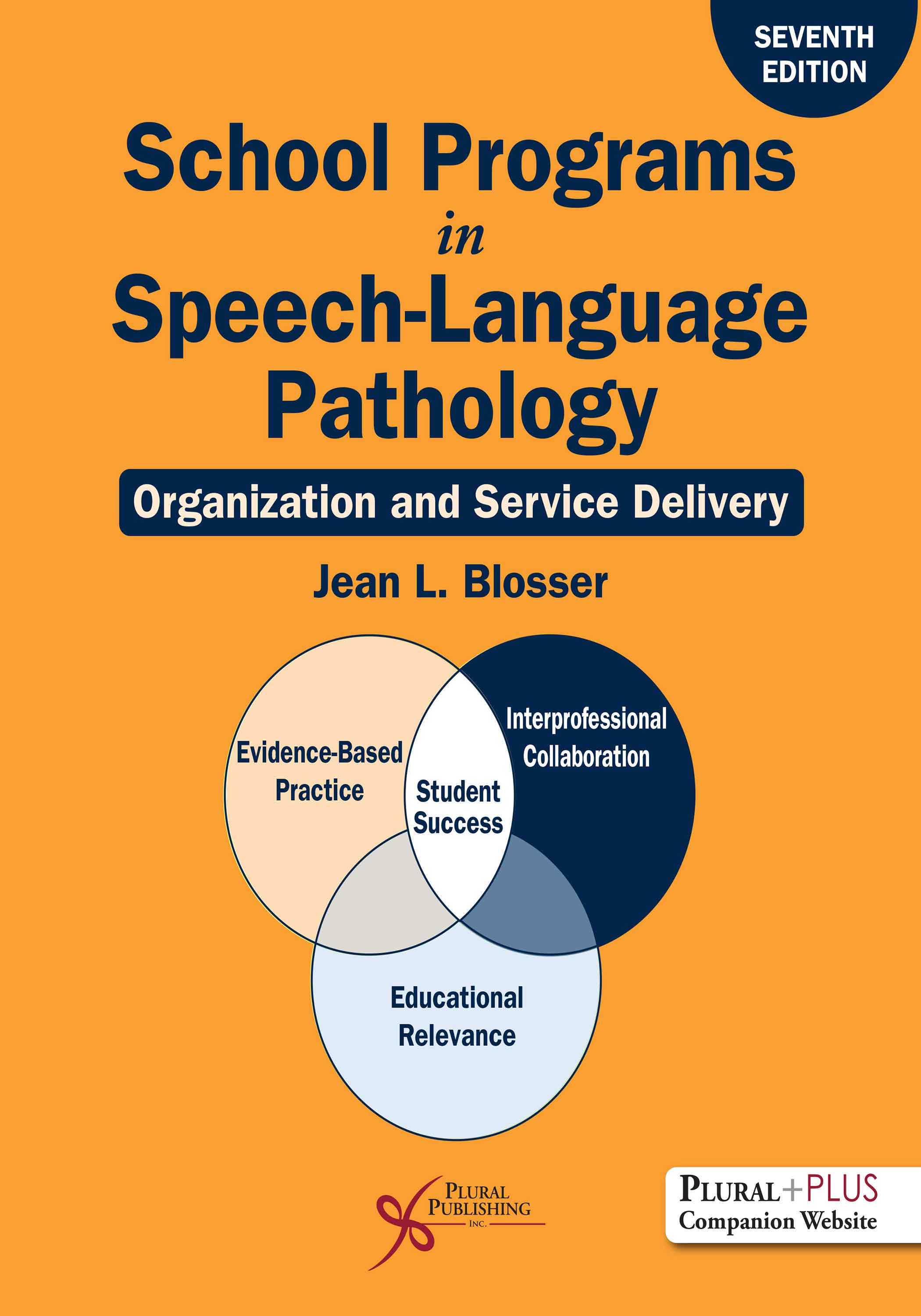
School Programs in Speech-Language Pathology: Organization and Service Delivery
Seventh Edition
Jean Blosser
Details: 457 pages, B&W, Softcover, 8.5 " x 11"
ISBN13: 978-1-63550-611-2
© 2025 | Available
A Guide to School Services in Speech-Language Pathology
Fifth Edition
Trici Schraeder, Courtney Seidel
Details: 313 pages, B&W, Softcover, 8.5" x 11"
ISBN13: 978-1-63550-670-9
© 2026 | Available
Professional Communication in Speech-Language Pathology: How to Write, Talk, and Act Like a Clinician
Fifth Edition
A. Embry Burrus, Laura B. Willis
Details: 280 pages, B&W, Softcover, 7" x 10"
ISBN13: 978-1-63550-658-7
© 2026 | Available
Multi-Tiered Systems of Support: Implementation Tools for Speech-Language Pathologists in Education
Second Edition
Lesley Sylvan
Details: 363 pages, B&W, Softcover, 7" x 10"
ISBN13: 978-1-63550-780-5
© 2026 | Available